Space and Physics
 PUBLISHED


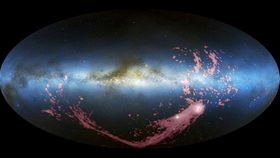


A gruesome crime is being committed by our galaxy. Slowly but surely, the Milky Way is performing an act of galactic cannibalism, stealing the gas from one of its two nearby companions, the Large and the Small Magellanic Clouds. What we weren’t sure is which one was the true victim of the Milky Way’s hunger, but thanks to Hubble, we have now discovered what’s happening.
The gravitational attraction of these three bodies has created trails of gas between and around them. The investigation focused on the Leading Arm, an arching bridge of gas that connects the Magellanic Clouds to the Milky Way. This is a real-time example of gas accretion, an important process in galaxy mergers.
As reported in the Astrophysical Journal, the team used the Hubble Space Telescope to study the composition of the Leading Arm and compared it to the chemical signatures seen in both companion galaxies.
“There’s been a question: Did the gas come from the Large Magellanic Cloud or the Small Magellanic Cloud? At first glance, it looks like it tracks back to the Large Magellanic Cloud,” lead author Andrew Fox, of the Space Telescope Science Institute, said in a statement. “But we’ve approached that question differently, by asking: What is the Leading Arm made of? Does it have the composition of the Large Magellanic Cloud or the composition of the Small Magellanic Cloud?”
The evidence collected shows that, based on composition, the Leading Arm is likely a product of the Small Magellanic Cloud. The complex tug-of-war had its victim in the smaller galaxy, which still weighs a whopping 6.5 billion times our Sun and is 3,500 light-years across.
These gas streams are believed to be common around other galaxies, but they are very difficult to study. Even studying the Leading Arm has not been easy. The observations were only possible in ultraviolet light and since this is absorbed by the atmosphere, the researchers had to use Hubble.
“Hubble is the only game in town,” explained Fox. “All the lines of interest, including oxygen and sulfur, are in the ultraviolet. So if you work in the optical and infrared, you can’t see them.”
The team is now planning to expand their observations of the Leading Arm and eventually map the entire stream of gas, which connects the Milky Way to the Magellanic Clouds