Space and Physics
 PUBLISHED


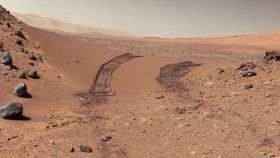


Planetary scientists have released a new map of Mars, identifying the likely location of significant ice deposits below its surface. Today the Red Planet is a frigid dry desert, but in the ancient past, the planet was covered in water. Some of that water still exists below the surface.
Understanding water availability is key for future human exploration of Mars. The new work, published in Nature Astronomy, combines orbital data sets from NASA’s Mars Reconnaissance Orbiter, Mars Odyssey, and Mars Global Surveyor. The data was reprocessed with new computing techniques, and with that, the team delivered the SWIM (Subsurface Water Ice Mapping) study.
The map shows widespread deposits of ice as low as 30 degrees of latitude North, but the distribution is not equal across the planet until around 50 degrees. The ice deposits are diffused in a wide range of depths – as shallow as a handful of centimeters, all the way down to one kilometer (0.6 miles).

“The goal of SWIM is to provide maps of potential buried ice deposits to support the selection of human landing sites. Ice is a critical resource that has many uses, like the generation of water for human consumption, growing plants for food, and for the generation of methane fuel and breathable air. But the most important is to provide fuel for the return trip home to Earth,” lead author Dr Gareth Morgan, from the Planetary Science Institute, said in a statement. “Taking all the fuel you need for the round trip to Mars is basically not feasible and as a result pretty much every mission concept study from the last 30 years considers exploiting the Martian environment for fuel.”
Ice is an important resource if future explorers will have to make fuels out of it, but this is not the only consideration. The location is crucial too, as some areas of Mars get too cold and dark as the season changes. The planet is already extremely inhospitable for humans without having to add more complications.
“Of course, safely delivering humans to Mars and ensuring their survival requires many other considerations beyond in situ utilization of water resources, including landing-site safety and solar and thermal specifications. Defining such site requirements is beyond the scope of the SWIM project and would be premature, given that all human Mars mission plans are still in the conceptual stage,” Morgan concluded. “We provide a hemispheric perspective of ice distribution to support initial landing-site studies and enable the community to explore the range of Martian terrains that host ice.”