Space and Physics
 PUBLISHED
 1
1


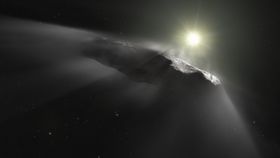


Last year, astronomers spotted the very first interstellar visitor to our Solar System. They called it ‘Oumuamua (oh-MOO-a-MOO-a), the Hawaiian word for "scout", and in the last 13 or so months it has been studied extensively. Of course, nothing new can be discovered in space without people screaming "Aliens!".
The SETI (Search for Extra-Terrestrial Intelligence) Institute was of course curious, and has now released its observations of the object in a paper to be published in the February 2019 issue of Acta Astronautica. Their findings: sadly no radio transmissions have been detected from this interstellar object.
“We were looking for a signal that would prove that this object incorporates some technology – that it was of artificial origin,” lead author Gerry Harp said in a statement. “We didn’t find any such emissions, despite a quite sensitive search. While our observations don’t conclusively rule out a non-natural origin for 'Oumuamua, they constitute important data in accessing its likely makeup.”
From the shard of an alien planet or spacecraft to a mission sent to spy on us, conspiracy theories about ‘Oumuamua have been rife – and scientists haven't helped. A couple of recent studies argued that the object doesn’t behave like any known comet or asteroid, as reported here for Scientific American. One study even argued that ‘Oumuamua has all the hallmarks of being a solar sail, a high-tech device that it is propelled by starlight.
The object is unusual for sure, but peculiar is not a synonym for being artificial. If the argument for being of alien origin is to be flippant about properties we can’t easily explain with natural causes, we can find easily holes in the artificial explanation, and are left with many questions.
If it’s artificial in origin and was sent by an alien intelligence to the Solar System, what is its purpose? If it’s collecting data, why is it not transmitting it? If we were to send a mission to another star, would it end up looking like this?
Among the things that are still unclear about ‘Oumuamua, there is something we have been able to measure and that's its speed. It’s fast, moving at 26.33 kilometers (16.33 miles) per second. But it is not fast enough that it cannot be explained by perfectly ordinary phenomena. And actually, when it comes to interstellar distances, it is quite slow. It would take 49,000 years to get to our nearest star.
Maybe these alien civilizations don’t care about having immediate results, but having to wait millions of years to reach another star seems to be an unrealistic level of patience.