Space and Physics
 PUBLISHED




It took the latest observations of the universe and two independent teams of astronomers but finally, we found where the missing regular matter of the universe has been hiding. And no, it wasn’t behind the sofa.
We think the universe is made of regular (or baryonic) matter, dark matter, and dark energy. We don’t know what dark matter or dark energy are, and of the regular matter in the universe, it appears we are missing 50 percent. It has long been suspected that all these protons, neutrons, and electrons are inhabiting intergalactic space and the two new studies (available on the Arxiv here and here) tell us that this might indeed be the case.
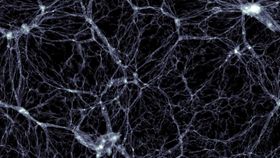
The latest research suggests that the missing matter is organized into filaments stretching from galaxy to galaxy. The gas in these filaments is hot but it has such an extremely low density that no telescope can directly observe it.
Luckily, this hot gas can leave a signature of its presence in the cosmic microwave background (CMB), the first light released by the universe after the Big Bang. The low-energy photons of the CMB slam into the high-energy electrons in the gas filaments, stealing some of their energy. This is called the Sunyaev-Zel'dovich effect and it slightly changes what the CMB looks like.
But even the best observations of the CMB, conducted by the European Space Agency’s Planck telescope, are not enough to observe the effect of an individual filament. So the two teams had to be quite ingenious. They selected pairs of galaxies, identified where the connecting filaments would appear in the CMB map, and then stacked the signal. In the study led by Hideki Tanimura from the Institute of Space Astrophysics in Orsay, France, the team looked at 260,000 pairs of galaxies, while the other, led by Anna de Graaff from the University of Edinburgh, tallied over a million of them.
Both teams found that the space between galaxies is denser than expected. Tanimura’s team found that the gas is three times denser between galaxies than the mean density of normal matter. The value for de Graaff’s team was six times.
“We expect some differences because we are looking at filaments at different distances,” Tanimura told New Scientist. “If this factor is included, our findings are very consistent with the other group."
"The missing baryon problem is solved.”
This discovery will help us refine simulations and better tune future observations. For now though, we can be happy that at least regular matter is all accounted for.
[H/T: New Scientist]