Space and Physics
 PUBLISHED
 9
9


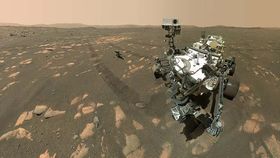


Perseverance’s “firsts” on Mars have come thick and fast, considering it’s only been on the Red Planet for 60 sols. Not content with the first-ever audio and the first-ever controlled flight on Mars, one of its instruments just extracted oxygen from the Martian atmosphere for the first time – something that could one day help astronauts live on Mars.
On April 20, the toaster-sized Mars Oxygen In-Situ Resource Utilization Experiment (MOXIE) converted carbon dioxide into 5.4 grams (0.19 ounces) of oxygen, NASA announced. This is equivalent to what an astronaut on Mars would need to breathe for roughly 10 minutes. This incredible milestone "points the way to future human exploration of the Red Planet," NASA said.
Like Ingenuity's first flight this week, the first powered flight on another world, MOXIE's experiment is a technology demonstration. Creating and storing oxygen on Mars could not only allow future astronauts to breathe on Mars, but could power rockets that could lift astronauts off the surface – vital for exploration, travel between potential bases, and returning space travelers to orbiting craft.
“This is a critical first step at converting carbon dioxide to oxygen on Mars,” said Jim Reuter, associate administrator of NASA’s Space Technology Mission Directorate (STMD), which sponsors MOXIE. “MOXIE has more work to do, but the results from this technology demonstration are full of promise as we move toward our goal of one day seeing humans on Mars. Oxygen isn’t just the stuff we breathe. Rocket propellant depends on oxygen, and future explorers will depend on producing propellant on Mars to make the trip home.”

It would take 7 tons (15,000 pounds) of rocket fuel and 25 tons (55,000 pounds) of oxygen to lift four astronauts off the Martian surface, way more than the 1 ton of oxygen four astronauts living and working on the surface of Mars for a year would need to breathe. Bringing this amount of oxygen from Earth is not practical, but bringing a scaled-up instrument that can convert carbon dioxide – which Mars has plenty of, as 96 percent of its atmosphere is CO2 – to oxygen would be far more economical and useful.
Carbon dioxide molecules are made up of one carbon atom and two oxygen atoms. MOXIE works by using an air pump to pull in carbon dioxide from the atmosphere, separating the oxygen atoms from the CO2 molecules by feeding it into the Solid OXide Electrolyzer (SOXE), where it is electrochemically split to produce pure oxygen.

Though the results of this first test are quite modest, MOXIE is designed to generate 10 grams of oxygen per hour, which is about 20 minutes of breathable oxygen an hour.
“MOXIE isn’t just the first instrument to produce oxygen on another world,” said Trudy Kortes, director of technology demonstrations within STMD. It's a huge step forward for plans for future astronauts to be able to "live off the land" and use elements readily available on another planet.
So, one small step for MOXIE, one giant leap for humankind.