Space and Physics
 PUBLISHED
 5
5


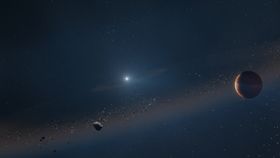


White dwarfs are the end process of stars roughly the size of our Sun. Once the hydrogen in their core is consumed they’ll swell up, slowly losing the outer layers, until eventually just a stellar core remains. This process is expected to disrupt and destroy the closest planets to such stars, but researchers have now found one that appears to have survived it, mostly unscathed.
An international team of astronomers reports on this survivor in the journal Nature. The planet orbits a white dwarf that is about 53 percent the mass of our Sun. The planet is about 1.4 times the mass of Jupiter and it is located 420 million kilometers (260 million miles) from its star. In the solar system, that’s roughly the distance between the Sun and dwarf planet Ceres, the largest object in the Asteroid Belt.
The existence of planetary systems surviving the dramatic phases of stellar evolution in white dwarfs has always seemed possible. After all, planets have been found surviving more cataclysmic events like supernovae. But so far, astronomers have only been able to find evidence of destroyed planets or asteroid belts. They also expected to find planets further out and not (relatively) this close.
Given that 97 percent of stars in the Milky Way are expected to take this path (although some won’t for maybe trillions of years), it is important to understand what might happen to their planetary systems. Estimations suggest that half of all the white dwarfs have Jupiter-size companions. And this is the first.
The planet was discovered thanks to a technique called microlensing. The planet’s gravity was enough to affect the light of its host star like a glass lens would distort the image and brightness of a candle. As the planet moves around the white dwarf, the light from the white dwarf then changes allowing astronomers to work out the presence of this world.
The team estimated the properties of this gas giant planet based on an original detection in 2010 and follow-up in 2015, 2016, and 2018. Based on that data, they come up with the current estimate of this system. A gas giant planet orbiting the end-of-the-line for stellar evolution. This planetary system is located 6,500 light-years away towards the center of the Milky Way.
The planetary system and the others that will certainly be discovered are a window to the future of the Solar System. When the Sun will turn into a red giant, it is expected that Mercury and Venus will be destroyed, and even Earth and Mars might have little chance of survival. Jupiter will still be there, even as the Sun turns into a white dwarf.