Space and Physics
 PUBLISHED
 2
2

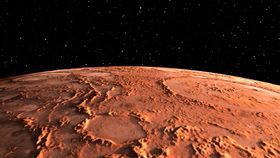


Alright, Earthlings, it’s time to stop complaining about how cold this winter is. After all, it could always be worse if we lived on Mars. Thanks to NASA’s Insight Lander, we can now see daily weather reports from the rocky Red Planet and let’s just say it is really, really frigid.
For example, this week had an average temperature of around -82°F. Uhm, no thanks.
It’s all part of InSight's mission – short for Interior Exploration using Seismic Investigations, Geodesy, and Heat Transport – to give Mars its first “checkup” in 4.5 billion years of existence. Located on the surface of a flat, smooth plain near the Martian equator known as Elysium Planitia, the weather-telling robot measures temperature, wind, and pressure. And right now, it has us dismissing the polar vortex with a hefty sigh.

“The InSight lander is close to the Martian equator – just north of the equator – so it is experiencing Martian winter,” said meteorological mission lead Don Banfield in a statement.
At the moment, Mars’ northern hemisphere is also in the middle of its stormy winter season.
“Since the lander is close to the equator, I didn’t think we’d see any evidence of the storms that are 60-degrees north latitude, but we’re already seeing evidence of the high and low pressure-signal waves that create weather on Mars,” said Banfield. “We can see those waves all the way down near the equator, as the waves are big enough that they have a signature. That was a surprise.”
“High and low pressure is indicative of the weather systems,” he said. “Compared to Mars, Earth is pretty chaotic. Mars has a nearly perfect, smooth sinusoidal (up and down) waves – it’s a very regular seesaw guided by a metronome on Mars. On Earth, the pressure is guided by a hyperactive child.”
Coldest temperatures average around -139°F near 5am Mars time. Just as on Earth, when the sun heats up the surface of Mars, the temperature warms up with a high of around 23°F. Scientists have also observed swirling dust devils.
In addition to forecasting weather systems, InSight is also recording tectonic activity and meteorite impacts as they happen in real-time, as well as monitoring the planet’s crust, mantle, and core.