Space and Physics
 PUBLISHED
 11
11


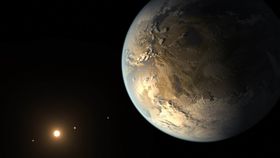


We've been neglecting an important factor in the search for life on other worlds, we've focused on temperatures without considering the importance of magnetic fields. Unfortunately, it seems that magnetic fields like the Earth's are very rare, suggesting almost all the planets we have found are devoid of life.
Mars and Venus both started out with plenty of water. Scientists are now convinced that the loss of their magnetic fields allowed solar radiation to break up water vapor from their atmospheres. The hydrogen escaped, making them the deserts they are today. So are all the exoplanets we are finding within stars' “habitable zones” likely to be Earth-like paradises or hell-holes like Venus? Australian National University PhD student Sarah McIntyre has modeled the chance of them having magnetic fields strong enough to make them places you'd want to visit.
Unfortunately, the news is bad for galactic hitchhikers. In the Monthly Notices of the Royal Astronomical Society (preprint available on arXiv) McIntyre reports that among a sample of 496 planets found around other stars, only one has even the possibility of a magnetic field stronger than that of Earth. Most have either none, or fields too weak to matter.
We can't measure magnetic fields of worlds beyond the Solar System directly, but a formula based on factors such as a planet's radius, the size and density of its outer liquid core, and known universal constants is thought to indicate field strength.
The Kepler Space Telescope has given us good indications of the radii of planets it has found. McIntyre told IFLScience it is thought the relevant core features can be derived from this, along with planetary mass and rate of rotation. More than 99 percent of the planets in McIntyre's sample are thought to be tidally locked, so that one side always faces their star, as the Moon does to Earth, so the period of rotation matches the time they take to orbit.
To put the final nail in the coffin of these worlds' chances of hosting life, most of them orbit M-type stars (red dwarfs), which are prone to spectacular outbursts of radiation that mean fields even stronger than that of our own planet would be required to protect any precious water.
All this may help explain the absence of extra-terrestrial visitors and also serve as a reminder that our home is precious. McIntyre acknowledges our planet-finding methods have created a skewed sample, particularly in the oversampling of tidally locked worlds, and suggests these should be broadened.
The paper contains a plea to prioritize planets likely to have strong magnetic fields for future studies, something McIntyre told IFLScience isn't happening with missions underway and planned.
The sole exception in McIntyre's sample is Kepler-186f, which orbits a K-type star, making it doubly worthy of further investigation.