Space and Physics
 PUBLISHED

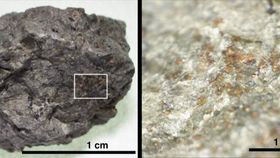


A famous 4-billion-year-old meteorite from Mars holds within its crust organic molecules containing nitrogen, suggesting that the Red Planet may have once hosted the right environment for early life.
The Allan Hills (ALH) 84001 meteorite – so-named for the area of Antarctica that it was found on in 1984 – contains orange-colored carbonate minerals that likely precipitated from salty liquid water on Mars billions of years ago.
The asteroid itself ejected from the Martian surface some 15 million years ago, bringing with it nitrogen-bearing organic material found within carbonate minerals. Such minerals may record Mars’ early aqueous environment, including nitrogen, an essential element for all life on Earth and a necessary component of proteins, DNA, and RNA.
The findings, which are published in Nature Communications, suggest that early Mars was wet and possibly rich in organic material, potentially making it a habitable place for life. Recent studies analyzing sedimentary rocks and meteorites present similar evidence and previous expeditions have found sulfur and chlorine-bearing hydrocarbons, but little is known about their origin, evolution, and whether these compounds played a role in biological life.
Previous examinations of ALH were contaminated with land material from Antarctic snow and ice, making it difficult to determine what belonged to the meteorite. To compensate for this, a research team from the Earth-Life Science Institute at the Tokyo Institute of Technology and the Institute of Space and Astronautical Science at Japan’s Aerospace Exploration Agency used silver-tape, which measures just the width of human hair, to pluck tiny grains of carbonate from the meteor. A scanning electron microscope was then used to detect the presence of nitrogen and determine associated chemicals and compounds. These were compared against igneous minerals that did not contain nitrogen.
The research team say they are confident they have found nitrogen content preserved within the carbonates, which indicates that Mars may have been more “Earth-like” before it became the Red Planet. Today, the surface of Mars is too harsh for organics to survive but some scientists believe that organic compounds may be similarly preserved in the Martian near-surface for billions of years, as appears to be the case with ALH84001.
The discovery opens up more questions about potential early life on Mars – where did nitrogen-containing organics come from in the first place?
“There are two main possibilities: either they came from outside Mars, or they formed on Mars. Early in the Solar System's history, Mars was likely showered with significant amounts of organic matter, for example from carbon-rich meteorites, comets and dust particles. Some of them may have dissolved in the brine and been trapped inside the carbonates,” said scientist Atsuko Kobayashi from the Earth-Life Science Institute (ELSI) at Tokyo Institute of Technology in a statement.