Space and Physics
 PUBLISHED
 2
2



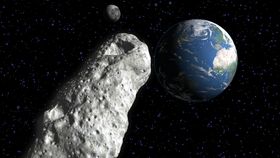


On Tuesday, February 22, Asteroid (455176) 1999 VF22 will fly past Earth at around 2:54 am EST.
This object is classified as "potentially hazardous" as it gets near our planet and is fairly large, but next week's flyby is perfectly safe. The space rock won’t get closer than 5,366,000 kilometers (3,334,000 miles) – that’s almost 14 times the distance between the Earth and the Moon.
NASA’s Small-Body Database gives an absolute magnitude for the object of 20.7, but without an albedo – the fraction of reflected light by the surface – it is very difficult to estimate its true size. The ballpark figure is between 190 and 430 meters (623 to 1,410 feet), and some observations in 2019 estimate it at 225 meters (738 feet).
This is the closest passage that this space rock will have with our planet for over a century. For this asteroid to pass closer to our planet than next week’s encounter one would have to wait until 2150 – coincidentally also around the same date, February 23.

Its closest previous encounter was in 1999, on October 31. Despite being large and close to Earth, it was actually not discovered until days later on November 10 by the Catalina Sky Survey.
If you want to try to see it pass by, you’ll need a good telescope – or you can check out the live stream of our friends at the Virtual Telescope Project starting at 7 pm EST on February 21 below: