Space and Physics
 PUBLISHED
 5
5


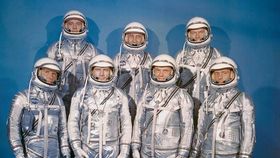


Would you have what it takes to be NASA’s first astronaut? Now’s your chance to find out with this interactive quiz.
Back in the late 1950s, NASA was looking for the best of the best to form the first-ever class of US astronauts. They started by gathering over 500 service records of the Air Force’s most stand-out test pilots, from which 110 candidates were assembled. After an intense stream of interviews and written tests, the NASA selection committee cut them down to 32. A final set of psychological, intellectual, and physical exams then whittled them down to just seven. These select few came to be known as the Mercury Seven: Scott Carpenter, Alan Shepard, John Glenn, Deke Slayton, Gus Grissom, Wally Schirra, and Gordon Cooper.
Would you have "the right stuff" to make it this far? For starters, all candidates had to be younger than 35, have a scientific or engineering college degree, weigh less than 81 kilograms (180 pounds), have 1,500 flight hours under their belt, and be under 180 centimeters (5 feet 11 inches) tall (NASA was very worried about room in the spacecraft).
If you manage to fit these incredibly specific criteria, then next you need to prove that your physical fitness is tip-top. All candidates had to have absolutely no hint of underlying physical or mental health conditions. NASA was also particularly obsessive about their candidates having very study hearts and excellent cardiovascular health. Slayton, one of the original NASA Mercury Seven astronauts, was eventually cut from the program in 1961 when it was revealed he had a slightly erratic heartbeat.
While we can’t recommend many of the physical and psychological exams – namely lots of stress tests in isolated chambers and extremely hot, cold, or cramped environments – you can attempt some of the intelligence tests used to assess the would-be spacemen’s problem-solving skills, mental reasoning, pattern recognition, and general intellect.
As first reported by Popular Science, check out the five quizzes below, featuring questions inspired by the 1958-1959 Mercury Seven selection program. Some of the questions are relatively painless high-school physics questions, others will make your brain carry out some lateral thinking and obscure reasoning.
[H/T: Popular Science]