Space and Physics
 PUBLISHED




As millions of people brace themselves for a spell of pretty bad weather, it turns out we're seeing a different type of storm altogether this week: a geomagnetic storm, being fired at us straight from the Sun itself.
The culprit is the Sun's coronal hole high-speed streams. Although the Sun is currently heading into its solar minimum – the phase in the 11-year solar cycle when it has the least activity – holes in the corona can still appear, and this means solar wind is free to escape into space. If the hole happens to be facing Earth, as one appears to be at the moment, then our magnetic field gets battered by a solar storm – and that's what we're seeing this week.
Despite certain alarmist headlines, the storm conditions are only moderate, peaking at a G2 class storm (on a scale which tops out at G5). For people living at high latitudes, that means potential problems at power stations as changes in the Earth's magnetic field trip voltage alarms and – if the storm lasts longer than experts expect – damage transformers. Satellites can also be affected as the Earth's atmosphere is slightly extended, and ham radio enthusiasts may see disruption as high-frequency radio wave propagation temporarily fades.
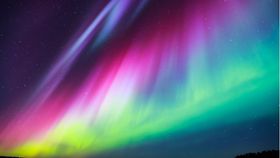
For many people, however, the most potent manifestation of the solar storm is, of course, the aurora borealis, or Northern Lights.
The sky was lit up with some spectacular aurora displays about this time last year thanks to a G3 solar storm – stronger than the one we're currently experiencing. However, the National Oceanic and Atmospheric Administration (NOAA) explains that a G2 storm can still produce auroras at latitudes as low as New York and Idaho – and this week's might see people in Scotland, Toronto, and even some areas of Illinois getting their cameras out to capture the display.

Even within these latitudes, the best place to see the aurora is somewhere with as little light pollution as possible, as local Anchorage reporter and aurora hunter Joe Vigil showed with his photos from Alaska.
The Northern Lights' less well-known (but equally beautiful) cousin, the Southern lights, or aurora australis, has also been visible thanks to the increased solar activity. Residents of Melbourne shared the snaps they took as their skies were lit up last night.
Although the storm peaked last night, NOAA expects it to continue – albeit only as a G1, or minor, class storm – until September 12. So if you haven't been able to see it yet, now's your chance – use NOAA's three-day aurora forecast to find out where to look. Happy hunting!