


 Space and Physics
 PUBLISHED
 3
3


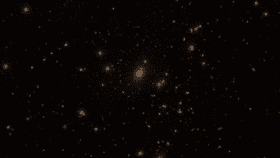


A group of German astronomers have used the MUSE instrument on the Very Large Telescope to study the motion of the stars at the center of galaxy Holmberg (or Holm) 15A, the central galaxy in a relatively close cluster of galaxies. These observations allowed them to measure the mass of its supermassive black hole – and it is a whopper.
Using direct dynamical detection, the team estimate the black hole to be 40 billion times the mass of our Sun, making it the most massive black hole in the local universe. When other estimation methods are taken into account, the black hole lands as one of the top four largest. The findings have been submitted to the Astrophysical Journal and are yet to be peer-reviewed. You can read the paper on arXiv.
Picturing something this big is often a struggle. The black hole is more than six times M87*, the black hole at the center of M87 whose shadow was photographed earlier this year. It is almost 10,000 times larger than Sagittarius A*, the supermassive black hole at the center of the Milky Way.
It is not only gargantuan in mass but also in size. Black holes are relatively small objects because they are incredibly dense. Cygnus X-1, a stellar black hole 14.8 times the mass of the Sun, is about 88 kilometers (55 miles) across. But Holm 15A* is so heavy that even this usually small value is mind-boggling. The black hole is 236 billion kilometers (147 billion miles) from one side to the other. That’s equivalent to 1,580 times the distance between the Earth and the Sun.
Holm 15A sits at the center of the Abell 85 cluster, a sizable group of galaxies that is currently experiencing at least two mergers with gas being thrown around in a slow but cataclysmic event. The merger between this large galaxy and other members of the cluster is likely to have contributed to the incredible size of the supermassive black hole.
The black hole is four times larger than what researchers expected for this galaxy based on the total mass of the stars and nine times based on the motion of the star. However, the estimated mass fits well with models that consider the core of the galaxy alone, suggesting that the merging events had a disproportionate impact on the central region rather than on the galaxy as a whole.
[H/T: Science Alert]


