Space and Physics
 PUBLISHED
 40
40


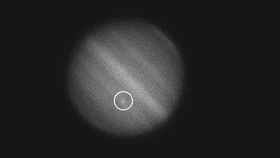


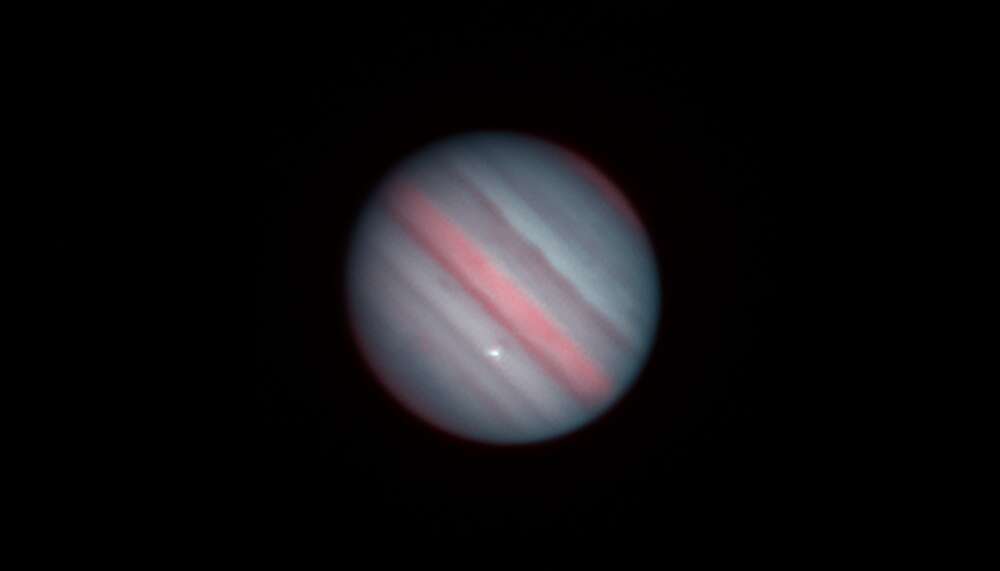
If Jupiter was sentient it might be wondering what it did to make space rocks hate it so much, because it just got hit for the second time in five weeks. In fact, such impacts are so common a gap of more than a month is probably something of a respite for the giant planet, but to capture them on camera is incredibly rare. This is the first time two have been filmed so close together (if you don't count the multiple associated impacts of Shoemaker-Levy).
Back on September 13, amateur astronomers across half the world spotted a bright flash as something large hit Jupiter. At least five of them filmed the impact. Incredibly, this was only the eighth impact event ever observed on Jupiter by humans.
Now an impact on October 15 has been reported by both a Japanese amateur astronomer who goes by @yotsuyubi21 on Twitter and Dr Arimatsu Ko of Kyoto University, making it the ninth observed event. This event, occurring at around the 12-second mark in the video below, is much fainter so most of the telescopes that picked up the September event may be too small to capture this one, but it was still big enough to cause a flash visible from Earth as it burned up in Jupiter's atmosphere.
Dr Ko has even provided images of the flash in different parts of the spectrum.
Jupiter's immense gravity and size means it will inevitably be hit by more bits of space debris than any other object in the Solar System. The first report of a Jovinian impact was in 1994. In that case, pieces of the comet Shoemaker-Levy 9 had been orbiting Jupiter for some time, and the rate of its orbital decay was calculated well beforehand. Space probes watched the event and Earth-based telescopes tracked the after-effects as Jupiter's rotation brought them round to face Earth, providing astronomers the first-ever direct observation of two bodies colliding in the Solar System.
Perhaps astronomers had witnessed impacts before, but prior to widely available video cameras, there was no way of confirming. The next filmed example came in 2009, and there has been one most years since. Using the 2019 impact astronomers estimated 20-60 events large enough to be visible from Earth occur each year. Others have produced lower estimates, but either way many of these are on Jupiter's far side, at times when the planet is close to the Sun from our perspective or otherwise unlikely to be observed. That still leaves a lot we could theoretically observe, and increasing numbers of amateurs recording through medium-large telescopes mean we are picking up more of them.
Such events may encourage more people to feast their eyes, and cameras, on the giant planet, but they can also be of scientific significance. We measure the speed of the winds in Jupiter's upper atmosphere by tracking molecules left behind from Shoemaker-Levy.
Shoemaker-Levy aside, the impacting objects are usually far too small for us to see directly at this distance – typically around the size of a house. However, the flashes they make as they burn up in Jupiter's upper atmosphere can be bright indeed.
Anyone else who filmed this flash – or any others – on Jupiter should contact the Organized Autotelescopes for Serendipitous Event Survey (Oases) here.
[H/T: Sky and Telescope]