Space and Physics
 PUBLISHED


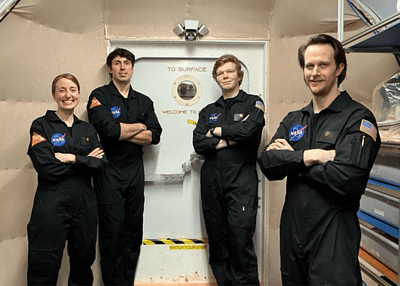


We aren't yet ready to send humans to Mars, but NASA is working on learning everything it can about what future astronauts might experience on the Red Planet. The method: running simulated Martian missions filled with challenges, hardships, and communication delays. The second mission is now past its halfway point, though the crew members are currently in a communication blackout.
On May 7, the CHAPEA (Crew Health and Performance Exploration Analog) mission 2 reached its 200th day. The crew entered the 158-square-meter (1,700-square-foot) 3D-printed habitat on October 19, 2025, and they will be out just in time for Halloween. The 378-day mission is going well with the four crewmembers having completed robotic operations, performed habitat maintenance, and grown crops.
“I’m proud of the crew’s accomplishments over the past 200 days — facing each challenge with fortitude and finding new ways to improve our performance and efficiency daily,” Ellen Ellis, medical officer for CHAPEA mission 2, said in a statement.
Ellis is there with commander Ross Elder, science officer Matthew Montgomery, and flight engineer James Spicer. The team experience simulated equipment failure, confinement, and resource limitations in the Dune Alpha habitat. They also experience communication delays lasting between 5 and 20 minutes, the range of time delays you can experience on Mars.
On top of that, currently they are experiencing a simulated two‑week loss of signal. This is meant to mimic what happens when Mars is behind the Sun from the point of view of Earth. During this time they will continue with the preplanned operation but cannot contact mission control, which, of course, keeps an eye on all the operations.
“We approach every day committed to doing our best work, whether we’re doing a simulated spacewalk, geology, exercise, a medical activity, or anything in between,” said Spicer. “What keeps us motivated is knowing that we’re contributing directly to NASA’s deep space exploration objectives.”
“Having limited resources, be it tools, equipment, software, supplies, or no internet, really bounds what you have to solve problems,” said Montgomery. “Finding creative and clever solutions has been both challenging and rewarding.”
There are many challenges when it comes to long-term human missions in space; if humanity is truly serious about spending a long time on another world, we ought to think about them and solve them. Speaking with the authors of the award-winning book A City on Mars, we have learned about some of the problems would-be Martians might expect.
“The first big surprise for me was how little we know about space medicine that is relevant to life in a space settlement. Hundreds of astronauts have been to space aboard stations orbiting the Earth, and I assumed we had learned most of what we needed to know from these astronauts and the experiments they ran in orbit,” Dr Kelly Weinersmith told IFLScience in an exclusive interview.
“What I would invest in immediately would be what are called closed-loop ecologies. These are systems in which you essentially have a sealed container and you create an ecosystem in it,” Zach Weinersmith told IFLScience. “Basically a mini-Earth. We’ve only done it a few times. So far the maximum scale we've done is eight [people] and we don't know how it scales.”
Missions like CHAPEA are beginning to provide some answers to those unknowns. CHAPEA provides data on cognitive and physical performance in such a simulated extreme environment, such as how people can deal with stress and stay productive.
“Extended-duration missions are relatively rare in NASA’s history to date,” said Sara Whiting, project scientist and mission manager at Johnson for NASA’s Human Research Program. “The operational lessons learned, along with the detailed health and performance data this crew is providing, come at the perfect time to inform the development of a sustainable lunar presence and longer-term objectives for crewed Mars missions.”
NASA is planning a third CHAPEA mission after this one concludes.