Humans
 PUBLISHED
 2
2


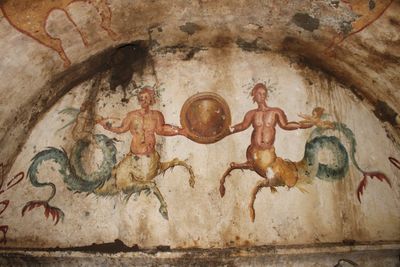


Archaeologists have discovered an exceptionally preserved and sealed chamber tomb in the municipality of Giugliano in Campania, Italy. The tomb is adorned with multiple frescos, the most notable of which depicts Cerberus – the three-headed guardian of the Underworld – which has given it the name the Tomb of Cerberus.
The tomb was discovered during an archaeological investigation in the Flegreo Domitiana area, which was part of a larger program for the “Completion and adaptation of the water supply system”, a statement released by the Italian Ministry of Culture explained.

Previous investigations have revealed that this site is densely packed with various burial sites, which display different burial rites (both inhumation and cremation) and come from the age of the Roman Republic (509 BCE to 27 BCE) and the Roman Imperial Age (31 BCE to 476 CE).
During their work, the archaeologists discovered an opus incertum – a type of facing that used Roman concrete or rubblework walls – which they initially believed marked the boundary of the necropolis. However, closer examination showed that it was actually the front of a “monumental” chamber tomb. This tomb was still sealed by the original tuff slab used to close the space. Behind this slab lay a large chamber that housed the amazing frescos that decorated its walls and ceilings.

The Cerberus fresco shows the titular three-headed hound from Ancient Greek mythology standing between a naked man, probably Heracles (Hercules to the Romans and Disney), and the messenger god, Hermes. The scene probably depicts the last of Heracles’ twelve labors, which required him to capture the chthonic doggo.
In addition to the fresco of Cerberus, the tomb also contains images of other mythological scenes, such as ichthyocentaurs (fish-horse-men) holding a clypeus – a shield carried by Greek hoplites and Romans. The two figures are being attended by two winged erotes – Roman cherub-like beings that are depicted as babies. These little gods were a collective group that, like Cupid, was associated with love and sexual intercourse.
The tomb’s inhabitant still remains on the funeral bed they were laid to rest on and is surrounded by a rich collection of objects. The chamber also contains an altar with vessels for libations.
There are still many questions associated with this amazing site, but the team continue to investigate it and hope to uncover more information about its owner.
“The emotion aroused by the privilege of such a discovery is indescribable”, Mariano Nuzzo, Superintendent of Archaeology, Fine Arts and Landscape for the Naples metropolitan area said in the statement.
“The territory of Giugliano, after years of oblivion, is finally returning significant vestiges of its glorious past, to be preserved and protected, thanks to a common effort."