Space and Physics
 PUBLISHED


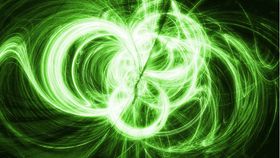


For over 11 decades we have known that matter and energy are interchangeable. The development of nuclear power has shown us that matter can be converted into energy, but converting energy into matter has so far proven a lot more difficult.
The battlefield for such an achievement is at the end of the most powerful lasers ever envisioned, currently being planned and built in a number of different countries. Three projects top the “one to watch list” of the laser world, prepared by the journal Science. They are China’s Station of Extreme Light (SEL), Russia’s Exawatt Center for Extreme Light Studies (XCELS), and the Department of Energy’s Optical Parametric Amplifier Line (OPAL).
These three lasers are planned to completely annihilate the current record for laser power, which is 5.3 million billion watts or 5.3 petawatts (PW) and obtained by Ruxin Li and colleagues at the Shanghai Superintense Ultrafast Laser Facility (SULF). Li is also behind SEL and hopes that by 2023 his team could reach the goal of a 100-PW laser.
The Russian instrument is still in the design phase of development but is more daring in its target. The researchers hope it will achieve 180 PW. Both SEL and XCELS are expected to work on the same principle. They shoot a series of pulses (four 30-PW pulses for SEL and a dozen 15-PW pulses for XCELS) and combine them into a single extra-powerful one.
Science Mag reports that this approach requires extreme precision and even the smallest vibration or temperature variation can compromise the achievements of such a powerful laser pulse. For this reason, OPAL is going a different way. It is envisioned to reach 75 PW with a single pulse.
There are other facilities working on “more modest” equipment that will aim to deliver 30-PW machines and SULF itself hopes to break the 10-PW record this year. High-energy is required but it is not the only necessity to “break the vacuum” and turn photons into electrons and positrons, their antimatter counterparts.
The way that SEL is expected to do this is very interesting. The laser will hit a helium target and liberate electrons. Some of the photons from the beam will ricochet off the electrons and then collide with other photons, creating particle-antiparticle pairs.
If SEL can truly break the vacuum, it could change the way we approach particle physics. Traditional particle accelerators might be swapped for faster and cheaper laser-powered ones.
[H/T: Science Mag]

 1
1