


 Space and Physics
 PUBLISHED



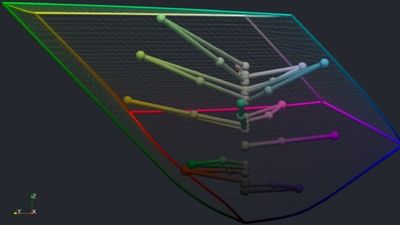


It’s a question that’s long plagued kindergarten philosophers: is your “red” the same as mine? Now, after more than a century of theorizing and investigation, we have an answer – and it took a lot of quantum physics, of all things, to get there.
“What we conclude is that these color qualities don’t emerge from additional external constructs such as cultural or learned experiences,” confirmed Roxana Bujack at Los Alamos National Laboratory in a January statement. Instead, they “reflect the intrinsic properties of the color metric itself,” she said.
Color, Bujack and her colleagues have shown, doesn’t require an external observer to describe it; rather, it can be defined entirely geometrically. “[The] metric geometrically encodes the perceived color distance,” Bujack explained – “that is, how different two colors appear to an observer.”
Now, all this is not an entirely new idea – in fact, the idea of defining color using geometry was first proposed more than a century ago, by none other than Bernhard “zeta function” Riemann and Erwin “potentially dead cat” Schrödinger. They got most of the way there: they figured out that color needs to be modeled in three dimensions, anchored to red, green, and blue – the three colors picked up most easily by human retinas – with all other hues and saturations contained within.
But they also got some things wrong. First of all, they figured that this 3D space was Riemannian – that is, that the distance, say, from red to green would be the same as the distance from red to orange to yellow to green. That, it turns out, isn’t true: one big color distinction tends to appear smaller than the sum of all those smaller steps.
And second, they didn’t finish the job. Schrödinger’s idea was that all colors could be connected via a kind of spine running from white to black – the “neutral axis” – but what he didn’t do was actually define that axis with any kind of rigor. Now, as any doctor will tell you, it’s pretty important to know where your spine is, or else the entire body might collapse – and that’s precisely the problem Bujack and her team faced while trying to fix the standard color model.
After mathematical modeling and experiments with human observers, “we suggest the following definition based on the perceptual non-Riemannian metric,” writes the team. “Within a plane of constant lightness […] the neutral color (the gray or the white) is the one that is closest to the black apex.”
It may sound small, but it makes a big difference: for the first time, the neutral axis could be defined solely using the geometry of the color metric. It closes what was a definition with a hole – and provides much-needed clarity in the sciences of color, vision, and optics.
“This work is just the beginning of probing the implications of non-Riemannian perception,” the paper concludes, “and we hope others will be inspired to build on these efforts.”
The paper, which was presented at the 2025 Eurographics Conference on Visualization, is published in the journal Computer Graphics Forum.


