Space and Physics
 PUBLISHED


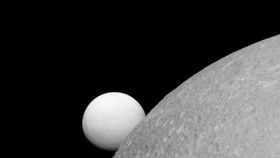


NASA’s Cassini spacecraft has captured a stunning image of two of Saturn’s moons hanging out.
Although you might not believe it by looking at them, Dione (near) and Enceladus (background) are composed of almost entirely the same materials – largely ice with a silicate core.
Their different appearances is largely down to how their surfaces reflect light. Enceladus is constantly sprinkled by ice grains spewed from its ice “volcanos.” This icy sheen means most of the light that hits its surface is reflected, giving it a fresher, lighter, snowball-like appearance.
Dione, on the other hand, looks a bit worse for wear. Its surface is covered in bruising craters from debris and radiation in a process known as “space weathering.”
Dione is 1,123 kilometers (698 miles) in diameter, while its little brother Enceladus is just 504 kilometers (313 miles) across.
There’s no fancy photography techniques going on here either. The image was taken in visible light by a narrow-angle camera onboard the Cassini spacecraft, 83,000 kilometers (52,000 miles) from Dione on September 8, 2015.