Space and Physics
 PUBLISHED





Supernovae in the Milky Way have been seen by humans since antiquity, and thanks to modern telescopes we have seen plenty of them in other galaxies. Astronomers might have now found something quite new: a supernova exploding in intergalactic space.
As reported in the Monthly Notices of the Royal Astronomical Society, the object is believed to be a rogue supernova remnant, the leftover material of a stellar explosion. The peculiarity that gained it the adjective "rogue" is that it’s located not inside a galaxy where these explosions are common, but on the outskirts of one.
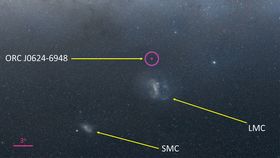
The supernova remnants, named J0624–6948, are located between the Milky Way and the Large Magellanic Cloud, the biggest of our galaxy’s satellites. The Large Magellanic Cloud is located roughly 130,000 light-years from us and is visible to the naked eye from the Southern Hemisphere.
“The most plausible explanation is that the object is an intergalactic Supernova Remnant due to an exploded star that resided in the Large Magellanic Cloud outskirts that had undergone a single-degenerate type Ia supernova which involves the explosion of two stars orbiting each other,” lead author Professor Miroslav Filipovic, from Western Sydney University, said in a statement.
When researchers first spotted J0624–6948, they first thought it was a much-further-away odd radio circle (ORC), peculiar structures much larger than galaxies that have recently been in the news. Or, the explanation might have been closer to home.
“However, we considered other scenarios such as that this object might represent a remnant of the super-flare activity from a nearby Milky Way star (at only 190 light-years away from Sun) that happened only a few centuries ago, or the premise that it may in fact be a much larger ORC,” professor Filipovic explained.
There are five known ORCs, and they all look similar. This doesn’t look like that, and the team couldn’t find a galaxy inside it. If it were as distant as the other ORCs it would be enormous, and they extend for millions of light-years.
The idea that this is a rogue supernova is compelling and currently the most likely scenario, based on the observations.
“What we’ve potentially then discovered is a unique remnant of supernova that has expanded into a rarefied, intergalactic environment — an environment that we didn’t expect to find in such an object. Our estimates point to the age of about 2200 to 7100 years old,” professor Filipovic added.
J0624–6948 was first spotted with the Australian Square Kilometre Array Pathfinder (ASKAP).