Ad

space-iconSpace and Physicsspace-iconAstronomy
clock-iconPUBLISHEDAugust 21, 2023
share120

Ring Nebula: A Dying Star Beams In The Depths Of Space In JWST's New Image

At a mere 2,500 light years away, the Ring Nebula is relatively close to Earth.

Tom Hale headshot

Tom Hale

Tom has a Master's degree in Journalism. His editorial work covers anything from archaeology and the environment to technology and culture.

Senior Journalist

Tom has a Master's degree in Journalism. His editorial work covers anything from archaeology and the environment to technology and culture.View full profile

Tom has a Master's degree in Journalism. His editorial work covers anything from archaeology and the environment to technology and culture.

View full profile
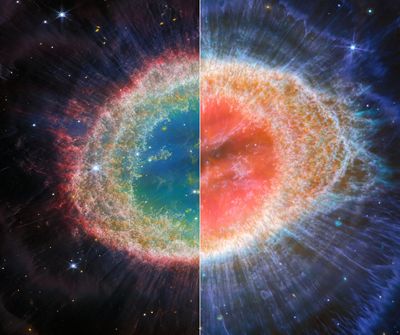
Two images side by side of the Ring Nebula. The image on the left shows Webb’s NIRCam view and the image on the right shows Webb’s MIRI image.

Two images side by side of the Ring Nebula. The image on the left shows JWST’s NIRCam view and the image on the right shows JWST’s MIRI image.

Image credit: ESA/Webb, NASA, CSA, M. Barlow, N. Cox, R. Wesson


JWST has captured a pair of beautiful images showing the Ring Nebula, a dying star in the midst of a final flurry at the end of its stellar lifecycle.

The rest of this article is behind a paywall. Please sign in or subscribe to access the full content.

Also known as M57 and NGC 6720, the Ring Nebula is typical of a planetary nebula, an ejection of ionized gas emitted from red giant stars late in their lives.

What you're seeing is essentially a fizzing outpour of gas being thrown out of a star at the center of the nebula. Once this drama is over, it will complete its transition to become a white dwarf, a small but super-dense body that's the final evolutionary stage for a star like the Sun.

The latest pair of images were shot by two instruments onboard JWST: NIRCam (Near-InfraRed Camera) captures the fine details of the filament structure of the inner ring, while MIRI (Mid-InfraRed Instrument) reveals the features in the outer regions of the nebulae’s ring.

This image of the Ring Nebula appears as a distorted doughnut. The nebula’s inner cavity hosts shades of blue and green, while the detailed ring transitions through shades of orange in the inner regions and pink in the outer region. The ring’s inner region has distinct filament elements.
Image credit: ESA/Webb, NASA, CSA, M. Barlow, N. Cox, R. Wesson

“The nebula is shaped like a distorted doughnut. We are gazing almost directly down one of the poles of this structure, with a brightly colored barrel of material stretching away from us. Although the center of this doughnut may look empty, it is actually full of lower density material that stretches both towards and away from us, creating a shape similar to a rugby ball slotted into the doughnut’s central gap,” the European Space Agency said in a statement

This image of the Ring Nebula appears as a distorted doughnut. The nebula’s inner cavity hosts shades of red and orange, while the detailed ring transitions through shades of yellow in the inner regions and blue/purple in the outer region.
Image credit: ESA/Webb, NASA, CSA, M. Barlow, N. Cox, R. Wesson

At a mere 2,500 light years away, the Ring Nebula is relatively close to Earth. It was first identified in the 18th century by astronomers Antoine Darquier de Pellepoix and Charles Messier, but has continued to fascinate scientists who use it as a useful example of a star entering its final evolutionary stage. 

It’s often described as one of the most one incredible astronomical objects in our skies – and looking at these images, it’s easy to see why. 


Written by 

Add us as a Google preferred source to see more of our
trusted coverage in Search