Space and Physics
 PUBLISHED



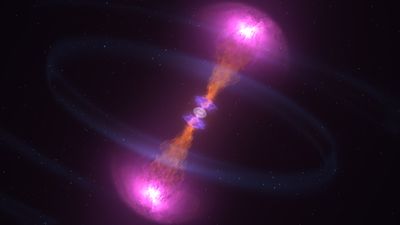


Gamma-ray bursts are incredible releases of energy. Some last for a fraction of a second, caused by the merger of neutron stars, while others last for many seconds and some even for minutes. These last ones are ultra-long gamma-ray bursts and are defined by a duration of more than 1,000 seconds, which is almost 17 minutes. Among those, an event recorded last year has puzzled scientists – because it triggered the telescopes that try to catch such events twice.
The event is called GRB 220627A and lasted for 1,095 seconds. Nothing too unusual there. But during the burst, there was a gap of about 600 seconds. The burst flashed into existence for a few minutes, disappeared for 10, and reappeared. The appearance and disappearance of the event set off the automatic system that looks for these events, but the observations are consistent with having the same origin.
The light of this event traveled for 11.6 billion years, making this the most distant ultra-long gamma-ray burst ever recorded. Researchers were also able to follow up on the event with different telescopes studying the afterglow of such an event. The question they wanted to answer is this: Are long and ultra-long gamma-ray bursts formed by the same event?
Over 70 percent of all gamma-ray bursts are in these two categories. The assumption is that they are produced by supernovae. And yet, recently, a neutron star merger was seen responsible for a minute-long gamma-ray burst. Something that was not expected to happen.
This has brought a little bit of chaos to the discipline. But it is good to question assumptions when new data comes in. Based on the evidence collected in this work, ultra-long gamma-ray bursts are also caused by supernovae – they only last longer than regular ones for yet-to-be-understood reasons.
The most interesting part, though, might be about the interruption in the signals. This is not the only interrupted event ever recorded. There are a few more in the data and the working hypothesis is this. A massive star goes supernova, leaving behind a magnetar, a neutron star with an enormous magnetic field. This ultra-dense object releases a powerful magnetic jet that produces the gamma-ray. But the magnetar is too heavy to be stable and collapses further into a black hole releasing a second slower jet producing the second weaker burst.
Another possibility is that the jet was rotating out of view, but the team seems to be skeptical of this because the scenarios where that would work best have much shorter quiescent periods. There is clearly so much more to learn about these extreme events.
The findings are accepted for publication in Astronomy & Astrophysics and are available at arXiv.
[H/T: Universe Today]