Health and Medicine
 PUBLISHED


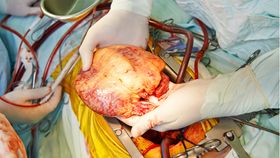


One of the major aims of modern medicine is to be able to grow human organs in a lab. This week, researchers announced they have managed to create a miniature human heart, in what they are calling a breakthrough. The amazing thing is that it started off as a rat's heart.
The researchers took the heart of a rodent and stripped it of the animal's own cells, leaving behind just the natural scaffolding of collagen and proteins. They then took human cells and pumped them through the structure in order to populate it with new cells. This worked and the researchers were left with a perfectly formed, rat-sized human heart.
The impressive achievement has been presented at the American Heart Association's American Basic Cardiovascular Sciences 2017 Scientific Sessions meeting, which is currently taking place in Portland, Oregon.
In order to do it, they first had to take the rodent heart and subject it to the already well established Langendorff method. This involved pumping the organ with fluid through the aorta, but rather than using a fluid that delivers oxygen and nutrients, they instead filled it with another that stripped the organ of the rat’s cells, and went further by filling the heart’s network of veins.
This left them with what is in effect the scaffolding of the heart, composed of collagen and other associated support proteins. The researchers then repopulated this matrix with human cells, which took to the scaffolding and grew. This 4-flow cannulation method allowed them to preserve the circulation within the heart, as well as stimulate the mechanical expansion of all four chambers.
The result was a miniature human heart, containing all four chambers, all the arteries and veins, valves and tissue. If this technique could be perfected, it could help in the creation of organs for transplants. The hearts produced would be far more suitable than current donations, as they could be created using a patient’s own cells, and thus remove the threat of the body rejecting the organ.
Since this experiment kept the structure of the rat’s original heart, the researchers also hope that it could be used to test drugs and hormones, and how they impact heart tissue not just in a dish, but also in three dimensions. This would give a much more accurate model as to what interactions and impacts any drug may induce.