Space and Physics
 PUBLISHED
 1
1






Since humans started using metals, metallurgists and smiths have tweaked and controlled the properties of their materials with appropriate temperatures and a good hammering. What if the next generation of materials could benefit from a similar approach at the quantum level? A team of researchers suggests just that.
Electrons in metals are mostly free to move as they please, which gives them their conductive properties. As metallic materials are cooled down, the electrons can organize in charge density waves, which are like neat little clusters. Researchers have shown that these clusters can behave like crystals, with the electrons forming an evenly spaced-out distribution.
“Electron crystals are not normally how we think of these things, but charge density waves have fascinated scientists for many generations, at least going back to the 70s, earlier than that in theory, but experimentally for the last 50 years,” corresponding author Robert Hovden, associate professor of materials science at the University of Michigan, told IFLScience. “To be able to control and manipulate and fully understand these charge density waves remains a challenge.”
When we consider new materials, we need to consider the properties of their electrons. The reorganization of electrons can turn a material from a conductor to an insulator, and more besides. Manipulating these electron crystals could unlock better materials, so the team looked at the behavior of a two-dimensional electron crystal in tantalum sulfide.
What they did appears to be analogous to regular melting, hence the idea of quantum metallurgy. Rather than melting the material, though, they only melted the electron crystals within. Because of this, it was only its electronic properties that changed, and in some very interesting ways.
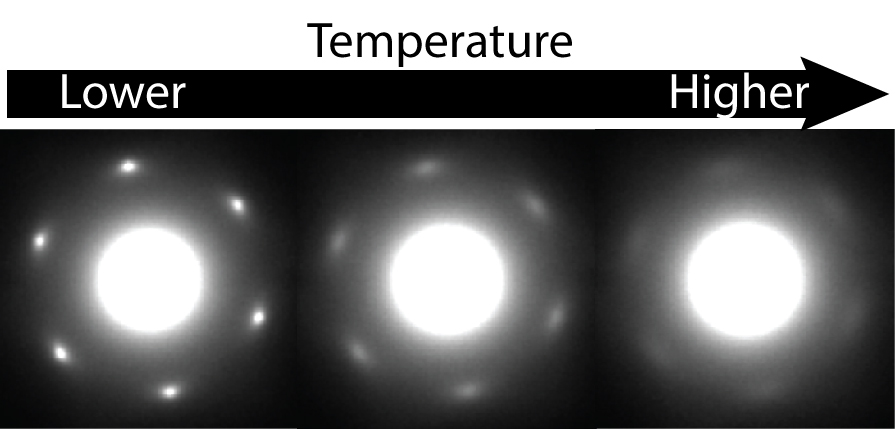
“There are two really cool things that we showed in this work. First of all, that these charge density waves are maybe better thought of as charged crystals when the electrons are forming their own crystal,” Hovden told IFLScience, “and that these crystals, they melt. And in two dimensions, they melt in a way that's unique to two-dimensional melting."
"The key emphasis here is that disorder is a really important parameter. It's this tunable thing when we're playing with quantum phases.”
Modifying the structure of electron crystals is extremely exciting. In superconductors, materials that transport electricity without resistance, the superconducting state can coincide with changes to charge-density waves.
“When we're doing basic science in these really exotic materials and exotic phases, dramatically new innovations happen,” Hovden told IFLScience. “Technological revolutions like the semiconductor, transistor, and computer happened because we did basic science on atomic structures, on atoms, on matter.”
Switching between conductor and insulator is how neurons, brain cells, transmit electrical signals. The ability to have a material do that at will could lead to artificial neurons for computing applications. And it might also aid in the continuing quest to find a superconductor that works at higher temperatures, so we could use it in everyday life.
The team looked at the electron diffraction patterns in 28 studies of other metals with charge density waves to see if there was evidence of melting of these electron crystals too. They found this to be the case in nearly all 2D metals they checked and several 3D metals. This suggests that it might be a common property that could give us access to a new way to tune materials.
A paper describing the results is published in the journal Matter.