Nature
 PUBLISHED





Greenland is, kind of infamously, not all that green. Legend has it that the name, along with that of the seemingly equally misnamed Iceland, was a Viking bait-and-switch: you give the nice, geothermally heated island covered in fertile volcanic soil a name that implies it’s some kind of permafrost realm, to discourage invaders, and label the desolate ice wilderness as some kind of green and pleasant land – because who really cares if you lose Greenland?
The truth, though, isn’t so simple. Iceland – first known as Snowland, which should probably clue us in as to the weather there – really was named after the copious amount of ice that was found there. At least, as far as we know: “At the start of a bitterly cold spring [explorer] Flóki [Vilgerðarson] climbed a high mountain and saw in the north a fjord full of drift ice,” wrote historian Robert Ferguson in his 2009 book The Vikings, “which led him to give the island its […] defining name of Ísland or Iceland.”
Greenland, on the other hand – well, there’s a bit of marketing going on there, it’s true. It was, legend says, settled by Erik the Red in the late 10th century, and he called it Greenland since “people would be more eager to go there because the land had a good name,” according to the 12th-century Íslendingabók.
The name may have been an exaggeration, but it wasn’t an outright lie. Greenland is too cold for much agriculture, it’s true, but it wasn’t always – the Vikings did manage it, and for a long time too. It’s only today that the name-swap theory really makes sense: Iceland is often verdant, warmed by the Gulf Stream and constant lava; Greenland, meanwhile, is too barren to maintain even a single forest across its more than two million square kilometers of land.
Well… okay, maybe there’s one.
Where in the world is Qinngua Valley?
As important as location is for a place’s climate, there’s really no accounting for geography. At 51.5 degrees North, for example, you could be in London, England, enjoying an average April temperature of around 15°C (60°F) – or you could be in Regina, Saskatchewan, where it’s about -6°C (21°F).
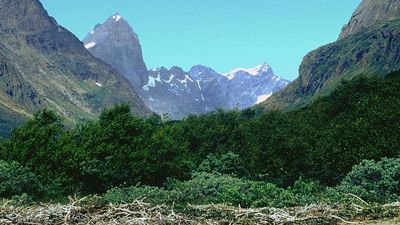
Similarly, you can find weirdly warm patches all over the world – all you need is some kind of mountain range or valley. That’s how we got the Atacama; it’s why the San Fernando Valley is so much hotter than LA; and, in southernmost Greenland, it’s how the Qinngua Valley is able to sustain a forest.
“Trees have been able to survive in these Southern Greenland locations because they lack permafrost and have borderline sub-arctic rather than Arctic tundra climates,” explains Atlas Obscura. “Temperatures rise above 10°C during the summer, the warmest on the island.”
“This climate occurs not only because the forest is at the southern tip of the island but also because mountains up to 2,000 meters tall block cold winds from the interior ice cap.”
It’s the only forest on Greenland, and it’s not much of one by global standards: it’s only about 15 kilometers long, extending in a roughly north-south straight line. To put that into perspective, the smallest national forest in the US is Tuskegee in Alabama, and it’s more than three times the size of Qinngua.
And while it may be “surprisingly lush,” write researchers at the University of Copenhagen, it’s also “species-poor. There are no conifers except for the creeping common juniper.” Other flora can, of course, be found there – you’ll commonly see a figure of about 300 species of plant recorded in the forest – but on a worldwide scale, it’s hardly a hotspot of biodiversity.
“The reason for the lack of species richness is found in Greenland's isolated position which makes it difficult for plants with heavy seed to invade,” explain the researchers. “This includes most of the conifers and species of the pea family.”
But like the forest itself, what native species lack in quantity, they make up for in uniqueness. With both birch and mountain ash growing together, Qinngua Valley is the only place on the planet where these Old World and New World species grow together natively.
A legendary history?
Qinngua Valley may hold the only forest in the territory of Greenland today, but that likely wasn’t the case back in the days of Erik the Red. Analyses of ancient pollen found in the peats and muds of Vatnahverfi, in the southeast of Greenland, have found areas that were likely even more forested than Qinngua before the Vikings arrived: “Vatnahverfi was a region with an abundance of woodland, relative to elsewhere,” conclude the authors of one 2014 study on the topic.
As soon as the Vikings settled the area, though, these arboreal pollen mixes changed – in fact, they kind of disappeared, being replaced by pollen from herbs and fungi. The culprit? “Likely […] the clearance of existing vegetation for the creation of hayfields,” the researchers explain, and “the presence of increased numbers of grazing herbivores in the landscape.”
In other words: there are no forests left in Greenland because the Vikings wanted to farm instead. And in Qinngua Valley, one very particular settler made his home: Erik the Red himself.
_Greenland._Salmon-trout_fishing_in_the_Qinngua_valley_(12168736363).jpg "A sepia photo of salmon fishing in Qinngua valley, taken some time around the turn of the 19th into the 20th century.")
At least, that’s what some people have said. “Having done a selling job on the supposedly verdant new land, Erik chose a location within what became Eiríksjiörðr for his homestead, which he called Brattahlið (‘the steep slope’),” explains a 2010 paper aiming to hunt down the location of said stead. “As befits (presumably) the most powerful man in Greenland during the landnám period, his farm might reasonably be expected to have comprised one of the largest areas of cultivable land […] in the extreme south of Greenland.”
In the 1920s, archaeologists thought they’d found the site – and it wasn’t in Qinngua. Excavations in Qassiarsuk, a little more than 11 kilometers north of Qinngua, revealed a large farm surrounded by four churches. “It was concluded that Qassiarsuk was the location of the Norse Brattahlið,” the paper notes. “That hypothesis has been generally accepted up to the present – locally, nationally, and touristically.”
Indeed, look at a map of the area today and you’ll see Brattahlið marked out – it’s a UNESCO World Heritage site, famous the world over as the first Norse settlement on Greenland. But according to one renegade archaeologist, Ole Guldager, it shouldn’t be.
“[Guldager] advances a claim for Qinngua […] as a more likely location for Brattahlið,” the paper explains. “In summary, Guldager points out that the size and number of ruins in Qinngua are much greater than those at Qassiarsuk, and […] contains an unexcavated church ruin which is central to his hypothesis.”
But does the idea hold up under scrutiny? The authors conclude that it doesn’t. “The farm construct, as posited by Guldager, is questionable,” they write, “and crucially, subsequent excavation has revealed that the only proposed ecclesiastical structure is probably not a church.” The location is suboptimal, they argue, and the confirmed vegetation doesn’t seem to fit the hypothesis.
For now, then, the location of Brattahlið remains at Qassiarsuk – though the Qinngua hypothesis, while unlikely, “is welcome,” the authors point out, “as it raises issues which should continue to be addressed.”
Until that changes, however, Qinngua Valley will have to stay as it is: notable only as the greenest land in Greenland, where the Old World meets the New.