Space and Physics
 PUBLISHED



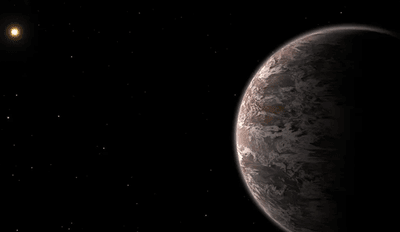


While there’s no weather forecast for Epsilon Indi Ab, JWST has produced a prospective weather report, which appears to involve clouds of water ice. There's a degree of uncertainty in that, but it's somewhat forgivable if you know Epsilon Indi Ab is 12 light-years from Earth.
The finding tells us something about gas giants beyond our Solar System and is causing excitement because it could be a precursor to similar detections on potentially habitable worlds.
One of the major reasons JWST was built was to detect the composition of atmospheres of exoplanets (planets orbiting stars other than the Sun). That remains a major challenge, and most detections have to be made when these planets pass in front of their stars and we can see the effect of the atmosphere on the star’s light.
However, since only a tiny fraction of starlight passes through an exoplanet’s atmosphere, the process is exceptionally challenging.
Elisabeth Matthews at the Max Planck Institute for Astronomy in Germany leads a team trying an alternative approach on cold, Jupiter-like planets, of which Epsilon Indi Ab was an early target. In the process, they have found signs they think indicate it has clouds of water ice like those we see on Earth.
“JWST is finally allowing us to study solar-system analogue planets in detail. If we were aliens, several light years away, and looking back at the Sun, JWST is the first telescope that would allow us to study Jupiter in detail. For studying Earth in detail, we would need much more advanced telescopes, though,” Matthews said in a statement.
Most of the planets we have found up to now orbit close to their stars, however, and are consequently very hot, making them unsuitable places to go looking for Earth-like atmospheric features.
Epsilon Indi Ab orbits a K-type star in the Epsilon Indi system, which also contains two brown dwarfs. Its orbit is about as far from its star as Uranus is from the Sun. Were it anything like as old as our Solar System, it would be extremely cold. However, it is young enough and its mass is great enough that it retains a lot of the heat from its formation. Uncertainty remains about its true temperature, but it’s probably close to 0°C (32°F).
“This planet has a considerably greater mass than Jupiter – the new study fixes its mass at 7.6 Jupiter masses – but the diameter is about the same as for its solar-system cousin,” said PhD student Bhavesh Rajpoot.
After blocking out the light from Epsilon Indi and applying filters that capture 10.6 and 11.3 μm light, the authors took advantage of Epsilon Indi Ab’s relatively strong infrared radiation caused by its warmth.
.png "When the light from Epsilon Indi A is blocked out the JWST can see its giant planet")
Jupiter’s clouds are mostly ammonia crystals, which block light at 10.6 μm, and the team anticipated Epsilon Indi Ab’s composition would be similar. But although the 10.6 μm filter indicated the presence of ammonia, it didn’t show as much as expected. After rechecking with the 11.3 μm filter, Matthews and her co-authors believe something is suppressing the ammonia emissions. When combined with Epsilon Indi Ab’s faintness between 3 and 5 μm, a feature common to two other cold giant exoplanets, they think the most likely explanation is patchy water-ice clouds, like cirrus clouds on Earth.
Most exoplanet atmospheric models ignore clouds, because they complicate things so much; as long as their absence is plausible, leaving them out is just too tempting. Now that will need to change.
“It’s a great problem to have, and it speaks to the immense progress we’re making thanks to JWST,” said postgraduate student James Mang at the University of Texas at Austin. “What once seemed impossible to detect is now within reach, allowing us to probe the structure of these atmospheres, including the presence of clouds. This reveals new layers of complexity that our models are now beginning to capture, and opens the door to even more detailed characterization of these cold, distant worlds.”
Theorists had better get started, because the Nancy Grace Roman Space Telescope is expected to be better suited to detecting light reflected from water-ice clouds in the atmospheres of planets that receive more starlight. If so, we might have lots of opportunities to calculate atmospheric composition based on cloud reflections.
The study is published in Astrophysical Journal Letters.