Nature
 PUBLISHED
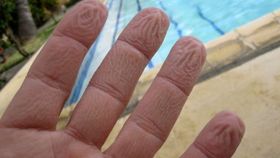


Aside from a built-in timer to get out of the bathtub, the ability for hands and feet to wrinkle after prolonged exposure to water may confer additional (and much more useful) evolutionary advantage. Research suggests that wrinkled palmar and plantar surfaces act as “tire treads” and allow for heightened grip in wet environments.
This function would have been useful to our ancestors, who may have spent a considerable amount of time in the water, trying to grasp fish for dinner. In a controlled experiment, the group that had soaked their hands prior to the experiment, resulting in wrinkled fingers, were able to perform underwater dexterity tasks more efficiently than the group that did not have hands that looked like raisins.
Though the constriction of the skin in wet environments was previously thought to be the result of osmosis, it is now understood to be a function of the autonomic nervous system: the system responsible for involuntary functions such as digestion, breathing, and heart rate. Individuals with nerve damage to the hands and feet are often incapable of getting wrinkly skin in response to water.
The morphology of the wrinkles on hands and feet are indicative of draining channels. As a wet surface is gripped, the grooves help push the water out of the way, allowing for better skin contact on the object.
The obvious question then becomes: “If it is so much better, why don’t we always have wrinkled hands?” Scientists hypothesize that the reduction in fingertip sensitivity when wrinkled is too costly, and the ability to adjust based on environment is a much better advantage.
This information has piqued the interest of those who subscribe to the Aquatic Ape Hypothesis (AAH), which claims that ancestral apes lived in water at least part of the time. Others, however, dismiss the idea, as these adaptations could have come from water being ever present in the environment without spending as much time in it as proponents of AAH would say. Adaptations that would allow those apes to exploit the water by using it as a source of food or transportation would have been a great advantage.