Nature
 PUBLISHED
 22
22


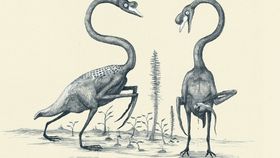


If you imagine a dinosaur, you perhaps picture a Tyrannosaurus rex much like the one in Jurassic Park, armed with a gaping jaw, disproportionately large head, and pathetically weedy arms.
Since we have no living subjects to go by, any depictions are largely based on fossilized skeletons. But are only fossilized bones a reliable foundation to imagine extinct beasts?
C. M. Kosemen, an Istanbul-based illustrator and paleoartist, has created a series of illustrations re-imagining our planet’s present-day animals as if they were depicted by artists who had no living inspiration to go by.
As you can see, they are way off the mark – and often downright terrifying.

Take his reimagining of an elephant (above left). If you were confronted with an elephant skull, you would have no idea that it actually possessed a 6-foot tube-like prehensile nose, nor would you expect it to be quite so thick and wrinkly.
A large part of the problem comes from being forced to guess the amount of soft tissue that would be wrapped around the bone. It’s perhaps easier to err on the side of caution and go easy on the soft tissue. Unfortunately, this often results in depictions of creatures looking extremely skinny, as you can see in Koseman's reimagining of a baboon (below).
It’s easy to see how these paleoart tropes can distort the way we depict extinct animals. We can see this in the way velociraptors have been reconstructed by researchers over the years. For decades, these Cretaceous-era creatures were assumed to look like agile and angry upright lizards, à la Jurassic Park. However, paleontologists now believe they were actually like a land-dwelling bird of prey with feathers and colorful plumage.

The most hilarious example of getting an animal spectacularly wrong came about when the skeleton of a woolly rhinoceros was unearthed in the mountain town of Quedlinburg, present-day Germany, in the mid-1600s. Since this was the 17th century, people had no knowledge of this extinct large-horned Ice Age animal, however, they did believe in unicorns. So, when the skeleton caught the attention of Prussian scientist Otto von Geuricke, he saw the skeleton’s large single horn and assumed it was a unicorn. Unfortunately, since the skeleton was missing most of its bones, his half-baked reconstruction of the unicorn-like beast looked, well, totally and utterly ridiculous.
For more of C. M. Kosemen's reimaginings of modern-day creatures check out his website.