Space and Physics
 PUBLISHED



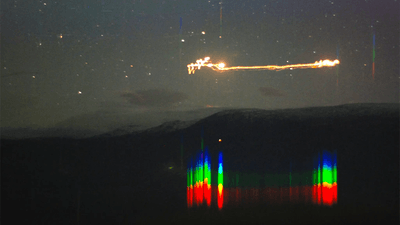


Since at least the 1930s, and possibly dating back to as far as 1811 CE, people have reported a strange luminous phenomenon above the valley of Hessdalen in central Norway.
"These lights could be anywhere. Sometimes they were reported to be just above the roof of the houses, or just above the ground," a paper on the topic explains. "Sometimes they could be high up in the air. Mostly the lights were reported to be below the tops of the mountains nearby. No one could give and explanations for these lights."
According to witness reports and a project set up to monitor the site for further lights, they are largely white or yellow-white and take on the shape of anything from a football-ish guise to looking like an upside-down Christmas tree. They appear to occur more frequently in the winter months, when light is lower, though they can occur in the daytime as well as at night.
Reports of unusual lights in the sky are themselves not that unusual. There are plenty of reports of unidentified aerial phenomena (UAP), and they are not all met with scientific investigations into their cause. But the Hessdalen lights, as they have been called, have been witnessed fairly regularly and have been photographed much more extensively than other aerial phenomena. There appears to be something going on there, but scientists remain a little stumped as to what exactly is happening.
Getting the more outlandish explanations out of the way, one single-author paper suggested that the lights could be caused by the mouths of tiny wormholes, hypothetical objects that connect two distant points in spacetime.
"The basic idea—a micrometric wormhole manifestation—is promoted here, and we suggest that the Hessdalen-type lights, seen pretty much everywhere in the world, may eventually be interpreted as a symptom of an unsuspected phenomenon deep in the subsoil of the considered site," that paper claimed.
While certainly a "fun idea," it's jumping the gun a little, especially considering some of the sightings of the lights have turned out to be a far-less-mysterious object known as "planes." The Journal of Scientific Exploration, in which the paper was published, is known to entertain some rather implausible ideas. Less speculative explanations, more grounded in physics, have been proposed to explain the lights as well.
One small research group from the University of Oslo, the University of Bergen, and the Norwegian Defence Research Establishment attempted to look into the phenomenon, documenting occurrences of the lights from the 1980s onwards.
Computer scientist Erling Strand and his team deployed a fairly extensive monitoring setup to study the lights in more detail, including radar, a magnetometer, radio spectrum analyzers, a seismograph, cameras, a Geiger counter, and an infrared camera. Eventually, they established a permanent observatory on site in an effort to catch further appearances as they streamed across the Norway sky.
Based on both the collected data and eyewitness accounts, the lights don’t behave in any single predictable way. Sometimes they drift slowly across the landscape; other times they seem to dart around erratically or change direction without warning. Their duration is just as variable, ranging from a few seconds to well over an hour. When people have been able to estimate their size, they’ve been described as roughly the size of a car.
Unfortunately, we really aren't very close to explaining these lights, or at least finding an explanation scientists agree on. One idea, proposed in a 2010 paper, suggests they are due to radon decaying in the atmosphere, as the area, and Norway as a whole, has one of the highest concentrations of radon in Europe.
"It is suggested that HL are formed by a cluster of macroscopic Coulomb crystals in a plasma produced by the ionization of air and dust by alpha particles during radon decay in the dusty atmosphere," that team wrote. "Several physical properties (oscillation, geometric structure, and light spectrum) observed in HL phenomenon can be explained through the dust plasma model."
Another explanation involves the piezoelectric effect. This is a phenomenon in which certain materials, and particularly crystals such as quartz, generate an electrical charge when they are compressed, stretched, or otherwise mechanically stressed, due to a resulting imbalance of electric charge across the material.
"In the specific Hessdalen area, where light phenomena are seen very often some meters over the ground, an electric triggering mechanism above might be produced by the existing high abundance of quartz, copper, and iron underground," one paper explains. "When quartz is subjected to tectonic stress, it generates piezoelectricity, while copper is an ideal electricity conductor and consequently might be an electrical amplifier of the HL phenomenon."
But scientists aren't altogether happy with these explanations. Others have suggested the valley may act as a sort of natural battery. The Hessdalen valley is split in two by a river, with zinc and iron-rich rocks on one side of the river and copper-rich rocks on the other. According to this idea, the anode of this "perfect natural battery" would be the zinc/iron section, while the copper half would be the cathode.
If you remember your high school science, what we are missing here is an electrolyte solution to transfer charge between the two sections of the battery, which would then discharge intermittently to explain the lights. According to this hypothesis, this could be supplied by local sulfur mines, potentially adding sulfuric acid into the mix.
"That these ghostly light balls are produced by an electrically active inversion layer above Hessdalen valley during geomagnetic storms. Puzzling geometric shapes and energy content observed in the HL phenomenon may be explained through a little-known solution of Maxwell’s equations to electric (and magnetic) field lines: they can form loops in a finite space, called 'unusual electromagnetic disturbance'," one team wrote of the idea.
While an interesting hypothesis, it isn't a slam dunk. Further research is needed, with the piezoelectric effect remaining a possibility also.