Space and Physics
 PUBLISHED


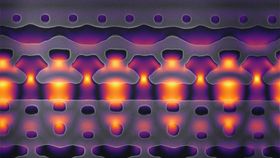


Most particle accelerator facilities are huge labs with very large instruments that can achieve incredible energies. These energies are necessary to probe what we don’t know of physics, chemistry, and biology. But while size matters, it is not essential.
Particle accelerators can be small, but the goal is to keep them powerful. And this is what has been achieved by researchers at the SLAC National Accelerator Laboratory in the US. They created a silicon chip that can accelerate electrons to a high speed in a distance smaller than the width of a human hair. A full-blown accelerator requires several feet to achieve the same result.
The new prototype is described in the journal Science. The team carved a nanoscale channel out of silicon, sealed it in a vacuum, and sent electrons through it. The acceleration was provided using infrared light because silicon is transparent to it. The infrared pulses push electrons along, delivering more energy compared to the microwaves used by the SLAC flagship accelerator.
"The largest accelerators are like powerful telescopes. There are only a few in the world and scientists must come to places like SLAC to use them," lead author Jelena Vuckovic of Stanford University said in a statement. "We want to miniaturize accelerator technology in a way that makes it a more accessible research tool."
While it's still early days, the team is really excited about the possible applications of their new chip. Just as the jump to personal computers has revolutionized the world, mini-accelerators could be useful to a variety of fields including biology and medicine.
In terms of aiding medicine, the miniaturized accelerator could be very helpful in cancer therapy. For example, tiny accelerators could be delivered to tumors just underneath the skin using a catheter.
"In this paper we begin to show how it might be possible to deliver electron beam radiation directly to a tumor, leaving healthy tissue unaffected," co-author Robert Byer, who leads the Accelerator on a Chip International Program (ACHIP), a broader effort of which this current research is a part.
To make the accelerator useful to research or medical applications, the goal is to accelerate electrons to 94 percent the speed of light. That's about 1,000 times more acceleration than what’s been achieved using the prototype. Luckily, all the accelerator functions are built right into the chip and the team believes they can achieve that energy level by the end of 2020.