Space and Physics
 PUBLISHED


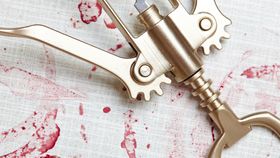


Say goodbye to wine-stained tablecloths. Daniel Perlman, a biophysicist from Brandeis University, has developed an ingenious solution to the annoying problem of droplets running down the side of a bottle after a glass of wine is poured.
The proposed new bottle has a groove below the lip – yes, that’s enough to stop drops from sliding down. The solution seems simple, but it required a few years of research to uncover how wine actually moves out of the bottle.
While there are products that already serve this purpose, Perlman wanted to figure out the physics to construct better bottles.
"I wanted to change the wine bottle itself," he said in a statement. "I didn't want there to be the additional cost or inconvenience of buying an accessory."
 GIF of wine being poured with a traditional bottle and a Perlman design. Brandeis University
The design required Perlman to carefully study how wine droplets adhere to the bottle and how the rate of flow affects the drippage. Using slow-motion videos, he noticed that the fuller the bottle of wine, the more easily drips formed.
The key to drip formation is how the stream behaves. As it escapes the bottle, wine forms a curl that touches the lip of the bottle and moves drops along the neck and eventually down towards the tablecloth.
Perlman, assisted by engineer Greg Widberg, used a diamond-studded tool to carve a groove 2 millimeters wide and 1 millimeter deep. When the wine is poured, the curl gets into the groove but is not able to go beyond it, so the wine in the curl drips into the glass and not along the bottle.
Perlman is currently speaking to bottle manufacturers to see if they’re interested in his discovery. After 200 years, it might be time to update the bottle design.