Health and Medicine
 PUBLISHED
 9
9


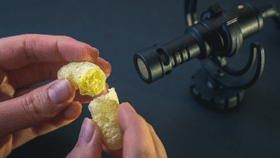


Do you tingle at the sound of the crunch of a pickle? To some people, certain sounds trigger revulsion or nothing at all but for others, it triggers an autonomous sensory meridian response (ASMR). It’s mostly felt as a tingling sensation that starts in the head and moves down the neck, and new research indicates it may be more common in people with anxiety and neuroticism.
For those who experience it, ASMR can be a deeply relaxing sensation and brought on by a range of triggers from — yup — pickle videos, whispering, scratching, crinkling, just about anything depending on your persuasion. Not everyone gets the same kick out of sound, but the paper, published in PLOS ONE, suggests the sensation has connections to personality traits.
To reach its conclusions, the study enlisted the help of 36 ASMR experiencers and 28 non-experiencers and tasked them with watching an ASMR video. All participants were also asked to complete assessments to detect neuroticism, trait anxiety, and assess their state of mind before and after the video.
The participants’ responses showed that ASMR-experiencers scored higher for neuroticism and trait anxiety and were more engaged with the video compared to non-experiencers. While the non-ASMR gang left the video in near enough the same state as they came to it, the ASMR cohort showed higher rates of anxiety in the before, but this was often alleviated by the video.
“Our study found that watching an ASMR video reduced anxiety in those who experience ASMR tingles even when previously not familiar with the phenomenon," the researchers said in a statement. "Personality characteristics which are linked with high anxiety were also associated with these benefits, therefore ASMR may be a suitable psychological intervention for anxious individuals in general.”
If found to be an effective way to manage state anxiety, the world certainly wouldn’t be short for content as in recent years ASMR videos have taken off online. Leading names in the ASMR influencer community have amassed millions of followers, with notable themes including glove sounds, haircutting, and ear licking.
As for ASMR as an anxiety prescription, it wouldn’t be the first time physicians have turned to unlikely sources for anxiety relief. In recent years, the Nature Prescription has garnered popularity in parts of the globe, aiming to soothe the symptoms of mild mental health issues with the great outdoors.
As we enter the third calendar year of a pandemic with “19” in its name, perhaps all this lip-smacking, pickle-crunching, whispering cinematography has been helping the masses cope in these enduringly unprecedented times.
Pickle, anyone?