Nature
 PUBLISHED


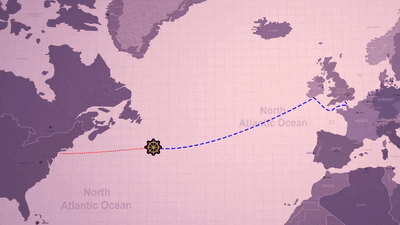


On April 15, 1912, an iceberg brought down a ship once thought to be unsinkable. The Titanic was the largest ocean liner of its time when it began its maiden voyage from Southampton in the United Kingdom to New York in the United States. Its journey ended in tragedy just four days into the Atlantic crossing, costing more than 1,500 lives.
The doomed vessel has been at the forefront of minds across the globe during the last couple of years following OceanGate’s Titan submersible that went missing while visiting the famous shipwreck, sadly resulting in the death of all five people on board. The harrowing situation has stirred up a century-old story, leading many to realize that the Titanic didn’t sink anywhere near where they’d imagined.
The Titanic's journey from Southampton to New York kicked off with a short leg across the English Channel to Cherbourg, France, and onto Queenstown, Ireland, which is now known as Cork’s port, Cobh. From here, it was near enough straight across the Atlantic to reach New York. Unfortunately, after four days and over 3,200 kilometers (2,000 miles), disaster struck. To be specific, an iceberg 640 kilometers (400 miles) off Newfoundland, an easterly province of Canada.
Records say that of the 2,201 passengers on board, 1,489 fell into the water and all of those were recorded as having drowned. However, the primary cause of death was suggested to instead have been immersion hypothermia in a 2003 paper, as people froze to death from being submerged in water that was -2.2°C (28°F).
The deadly freeze and giant pieces of ice apparently led many to believe that the Titanic was a lot further from America when it sank, as recent maps demonstrating the ship’s final resting place have taken a lot of people by surprise.
Another realization that shocked many following the recent disaster of the lost OceanGate submersible is the staggering depth at which the Titanic wreck sits in several pieces. Laying on the ocean floor, the wreckage is around 3,810 meters (12,500 feet) from the ocean’s surface and the two major pieces sit 790 meters (2,600 feet) apart, reports CBS News.
An earlier version of this story was published in 2023.