Humans
 PUBLISHED
 3
3


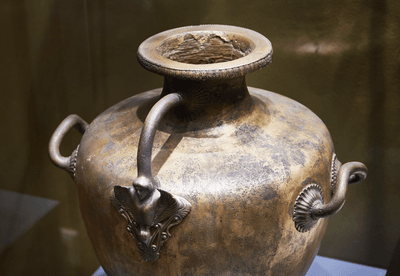


One for the road? Whoever was buried at the Shanjiabao cemetery around 2,300 years ago was sent off with a final parting gift: a bronze bottle filled with booze. The bottle, as well as 3.7 liters of beer-like goodness, were recently excavated in Northern China, although we really wouldn’t recommend chugging it.
Archaeologists recently discovered the ancient brew at the Shanjiabao cemetery near the city of Guyuan in the Ningxia Hui Autonomous Region, just 2 kilometres (1.2 miles) south of a stretch of the Great Wall of China.
The tomb dates to the end of the Warring States period (475–221 BCE), a tumultuous chapter in Chinese history that culminated in the unification of China under the Qin Dynasty. It was an era marred by civil wars and bloody rebellions, but also by an intellectual revolution and the rise of Confucianism.
With all that drama going on, people clearly needed something to take the edge off. In one of the tombs, the team discovered a bronze bottle with a garlic-shaped mouth, containing 3,740 millilitres of clear, light blue-green, and odorless liquid.
What did the ancient beer taste like?
The team extracted a small sample of the liquid, along with sediment from the bottle, and took it back to the lab for chemical analysis. Testing revealed more than 2,400 organic compounds, leading the study authors to conclude that the liquid was likely an alcoholic beverage.
Microscopic analysis of starch grains, phytoliths, and yeast reinforced that finding, while the presence of broomcorn millet and Triticeae (wheat or barley) indicated it was a cereal-based alcoholic drink, rather than a fruit-based wine.
This tipple would not have tasted like a lager, a pale ale, or anything enjoyed by modern beer drinkers – even craft beer connoisseurs would likely turn their noses up at it. The study notes that the liquid was relatively rich in lactic acid, oxalic acid, and tartaric acid, suggesting it had a sharp, sour taste – though that's probably a consequence of sitting in a dusty tomb for 2,300 years.
Beer didn’t arise out of civilization; civilization emerged out of beer
Beer, or something like it, is thought to have emerged in different parts of the world around the time when humans first started farming approximately 12,000 years ago
Some of the first crops to be domesticated were grasses, which eventually gave rise to cereals like wheat and barley. Somewhere along the line, people realized that if they soaked these crops and left them for a while, wild yeast would naturally ferment the mixture, creating an alcoholic brew — and drinking that ethanol-rich concoction would make them feel rather good (until the following morning).
Or maybe it was the other way around. A more controversial theory suggests that ancient humans were initially motivated to farm specifically to brew beer, not make bread. In other words, beer didn’t arise out of civilization; civilization emerged out of beer. Advocates of this idea suggest that alcohol can help to boost social cohesion and creativity, which is much more valuable to an emerging culture than mere bread.
By whatever means it came around, it appears that beer emerged independently several different times in different parts of the world, like an act of converged cultural evolution. In some cultures, it was perhaps a ceremonial tool, used by shaman-like figures to induce altered states and shift perceptions. In others, it took on a more practical role as a calorie-dense food source that, thanks to its alcohol content, was free of pathogens and far safer to drink than contaminated water.
The latest tomb-discovery in China seems to speak to humanity's deep, enduring, and occasionally problematic relationship with booze — then again, maybe this guy just really enjoyed sinking a few beers.
The new study was published in the Journal of Archaeological Science: Reports.