Humans
 PUBLISHED
 1
1


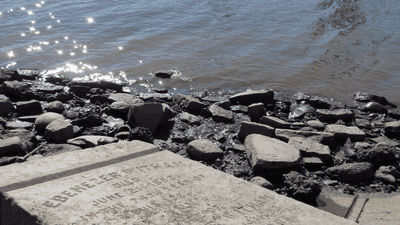


If you go walking beneath the Betsy Ross Bridge along the Delaware River, you will be met by a cascade of over 20,000 gravestones. The stones have been repurposed as rip-rap, foundational material that sits at the base of a breakwater or bridge, like the Betsy Ross. But how did they come to be here, and where are the bodies?
Among the thousands of gravestones to be found beneath the surface of the Delaware River is that of artist John Sartain. He moved to the US from London as a professional line engraver, painter, and illustrator with an interest in architecture.
In time, his skillset would bring him to the Monument Cemetery in Philadelphia, where he designed medallions for the George Washington and Lafayette monuments erected in 1869. Almost 20 years later, he returned as a resident, being buried in Monument Cemetery shortly after his death.

The land upon which the Monument Cemetery had sat was no stranger to transformation. First founded in 1837, it was created to be a calming and restful place for people to visit their dead loved ones, writes Hidden City – but as industry populated the neighborhood with factories and their associated pollution, it lost its pastoral charm.
It endured as a cemetery for over a century, but for Sartain and the thousands of other residents, it would not be their final resting place. In 1929, Monument Cemetery was finally full. With no space left to bury the dead, it had no income, and soon even minimum upkeep fell by the wayside.
Come 1956, it was condemned and changed hands to Temple University. They had no use for a cemetery but were after the land, wanting to clear it so it could be repurposed as a parking lot. However, that would involve moving a lot of people.

Several hundred families had to move their dead to be reburied alongside their grave markers at the Lawnview Cemetery in Montgomery County. However, Sartain’s remains were among over 20,000 that went unclaimed and so were exhumed and reburied in a mass grave. For those people, the tombstones did not travel with them and instead were repurposed for infrastructure.
Sartain’s gravemarker, the monuments he crafted, and the tombstones of thousands of other unclaimed dead were dropped into the Delaware River, where they can still be found to this day. Many are submerged too deep to be seen from shore, but there are some that remain visible at the river’s edge.
Not exactly what you expect to see when walking riverside, but did you hear about the shoes that kept washing up with feet in them?