Space and Physics
 PUBLISHED
 11
11



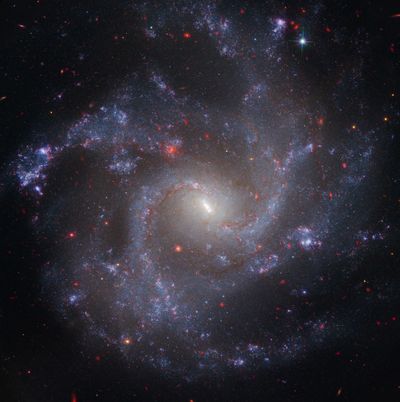


For the last several years, cosmologists and astronomers have been facing a major tension in our understanding of the cosmos. The expansion rate of the universe continues to be two different numbers depending on how we try and measure it. The cosmic microwave background – first free light in the universe – gives a value. Measurements of galaxies receding from us give another. These were taken by Hubble and one suggestion was a possible error somewhere. Follow-up observations are instead saying no.
Combining observations from Hubble with observations from JWST has strengthened the measurement of the expansion rate (also known as the Hubble constant) in the more local universe. And the value is definitely different from the one from the ancient universe. It seems that the fault is not in our stars but in our models.
“With measurement errors negated, what remains is the real and exciting possibility that we have misunderstood the Universe,” lead author and Nobel Laureate Adam Riess, a physicist at Johns Hopkins University in Baltimore, said in a statement.
To measure the distance of objects in the universe, there are a few methods. One uses Type Ia supernovae. These explosions have always roughly the same luminosity because they are created when a white dwarf steals enough material to catastrophically collapse and go boom. Since there is a single threshold for that limit, the light produced is always the same.
Knowing how luminous they are and measuring the brightness we get here – so how much they dimmed – we can work out the distance. Another class of objects for which this trick works are Cepheids variables. Astronomer Henrietta Swan Leavitt realized that their pulsation was linked to their intrinsic luminosity so we can work out the distance in a similar manner.
Type Ia supernovae are expected to happen once per century in a galaxy so, while bright, they are not that common. Cepheid variables are more common but one of the concerns with Hubble was that their light might be confused with other stars or affected by dust.
JWST can see through the dust and its keener eye can precisely spot the specific star without confusion. Its observations included five host galaxies of eight Type Ia supernovae containing a total of 1,000 Cepheids – so having two independent methods. The observations stretched out to 130 million light-years from us.
This data shows that errors in the observations of the Cepheids do not contribute to the Hubble tension. The discrepancy is not caused by bad measurements. “We’ve now spanned the whole range of what Hubble observed, and we can rule out a measurement error as the cause of the Hubble Tension with very high confidence,” Riess added.
The Euclid mission, launched last year, and some upcoming observatories might provide better insights into the tension just by the sheer volume of their observations. They may also help us realize how the current understanding of the universe, which has so far shown remarkable predictive ability, needs to be changed to make sense of what we see out there.
A paper discussing the results is published in The Astrophysical Journal Letters.