Space and Physics
 PUBLISHED


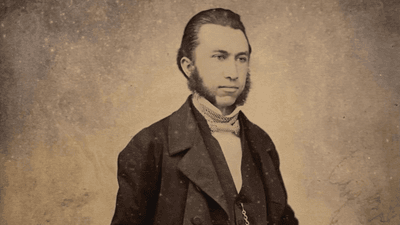


Researchers at the Royal Astronomical Society have identified what they believe is the only known photograph of Richard Carrington – the English astronomer best known for identifying the "Carrington Event" in 1859.
Born in London on May 26, 1826, Carrington first attempted to pursue mathematics before deciding that it was not for him.
"The tenour of my mathematical studies at the University of Cambridge, acting on mechanical propensities to which I had always been addicted, gradually made it clear to me that I was more naturally adapted for the pursuit of some physical science involving imagination and mechanical ingenuity," he wrote of his decision to pursue astronomy.
Carrington moved to the University of Durham, where he took the role of "Observer". Between October 1849 and March 1852, he remained at the university, observing comets, minor planets, and the solar eclipse of July 28, 1851, during a trip to Sweden. Through his work here, he earned a Fellowship of the Royal Astronomical Society in 1851. However, he became frustrated at the quality of equipment at the university, eventually leaving to build his own observatory using money borrowed from his father, a brewer who eventually became joint owner of the successful Royal Brentford Brewery.
At the observatory – Redhill – Carrington began to catalogue stars in the northern hemisphere above the poles.
"It is to be remembered that the account here given is addressed principally to a future astronomer who may in a far distant year repeat the examination of the star-positions of this region, when the particulars here supplied may be his only source of information on points which may then have an importance not now forseen," he wrote of his work there.
Though important and useful work, Carrington became interested in the work of Heinrich Schwabe, and in sunspots discovered on our host star's surface. From 1826 to 1843, Schwabe, a German amateur astronomer, observed the Sun, discovering that it rotates on its axis once every 27 days. He realized that over the course of 11 years, the Sun goes from quiet periods, where no sunspots can be seen, to the maximum phase, where 20 or more groups of sunspots can be seen.
"While the observation of stars for my intended Catalogue required the hours of the night and afforded little matter for speculation, the observation of the Sun [...] presented more variety and interest," Carrington wrote of this new pursuit.
On September 1, 1859, Carrington was observing the Sun when he made the discovery for which he is most widely known.
"In taking my customary observation of the forms and positions of the solar spots, an appearance was witnessed which I believe to be exceedingly rare," he wrote of that day, adding that he was an "unprepared witness of a very different affair".
In the previous month, astronomers had noticed a large number of sunspots as the Sun approached the solar maximum. Carrington, while observing and sketching the spots, saw a "white light flare" erupting from the solar photosphere. After 17.6 hours – much faster than it usually takes coronal mass ejections to reach Earth – it hit our planet. It caused some of the brightest auroras in recorded history, visible as far south as the Caribbean, and allowed people in New England to read in the middle of the night unaided by other light sources.
There were downsides to the event, including that the world's 200,000 kilometers (124,000 miles) of telegraph lines at the time were rendered temporarily useless. The event was the largest solar storm humanity has witnessed to date, and Carrington had captured the moments it left the Sun in his observations. He noted that fellow astronomer Richard Hodgson had also witnessed the event, though he avoided correspondence with him in order to keep their results independent.
Carrington died at home at the age of 49 of a cerebral hemorrhage, 10 days after his wife died, possibly of an overdose of chloral hydrate taken as a sleeping aid. His work established the prime meridian on the Sun, while his observations were used to identify the 27-day rotation period in solar magnetic activity, and that Earth's magnetic disturbances have their origins in solar activity.
He would perhaps be more widely known, other than for the Carrington Event, were there any photos to put to his name. For 150 years after his death, no such photo was known. But assistant archivist at the Royal Astronomical Society, Kate Bond, has likely found the first photo of Carrington himself.
Bond was discussing the astronomer with a colleague when she decided to search for photographs. There is evidence that Carrington was a member of the Literary and Scientific Portrait Club, a society that photographed members when photography was still in its infancy. Members had their photographs taken at the Maull & Polyblank studio in London. For many, this would have been the first photographic portrait they had taken, costing them 10 shillings and 6 pence per portrait, or around half a week's average wage at the time.
Following her conversation, Bond began searching the Internet for Maull & Polyblank photographs for sale.
Up popped "a photographic shop in the USA [...] selling a group of these photographs," Bond explained in Astronomy & Geophysics, "and one of them had 'the late Carrington' written on it in pencil on the mount."
"I bought it there and then," Bond added. "I thought to myself, 'If I’m wrong, I've just bought another picture of a Victorian man, but if I’m right...', well, I didn't want to see that chance slip away."
Looking at the photograph, Bond found that there was very faint writing on the image. Sending the photograph to the photographic department of John Rylands Library in Manchester, they attempted to determine whether the inscription was written at the time, or came from, for example, a letter placed on the photograph at a later time, smudged onto it.
"Their opinion," Bond added, "is that the lettering was almost certainly written on the back of the print before it was placed in the mount."
"In other words, it was written when the photograph was printed. This matters, because it says: 'R C Carrington, Esquire for C V Walker, Esquire'. And that was amazing, because CV Walker is Charles Vincent Walker (1812–82), a Fellow of the Royal Society and also a Fellow of the RAS."
"He knew Carrington well, as he nominated him for his FRS [Fellowship of the Royal Society]."
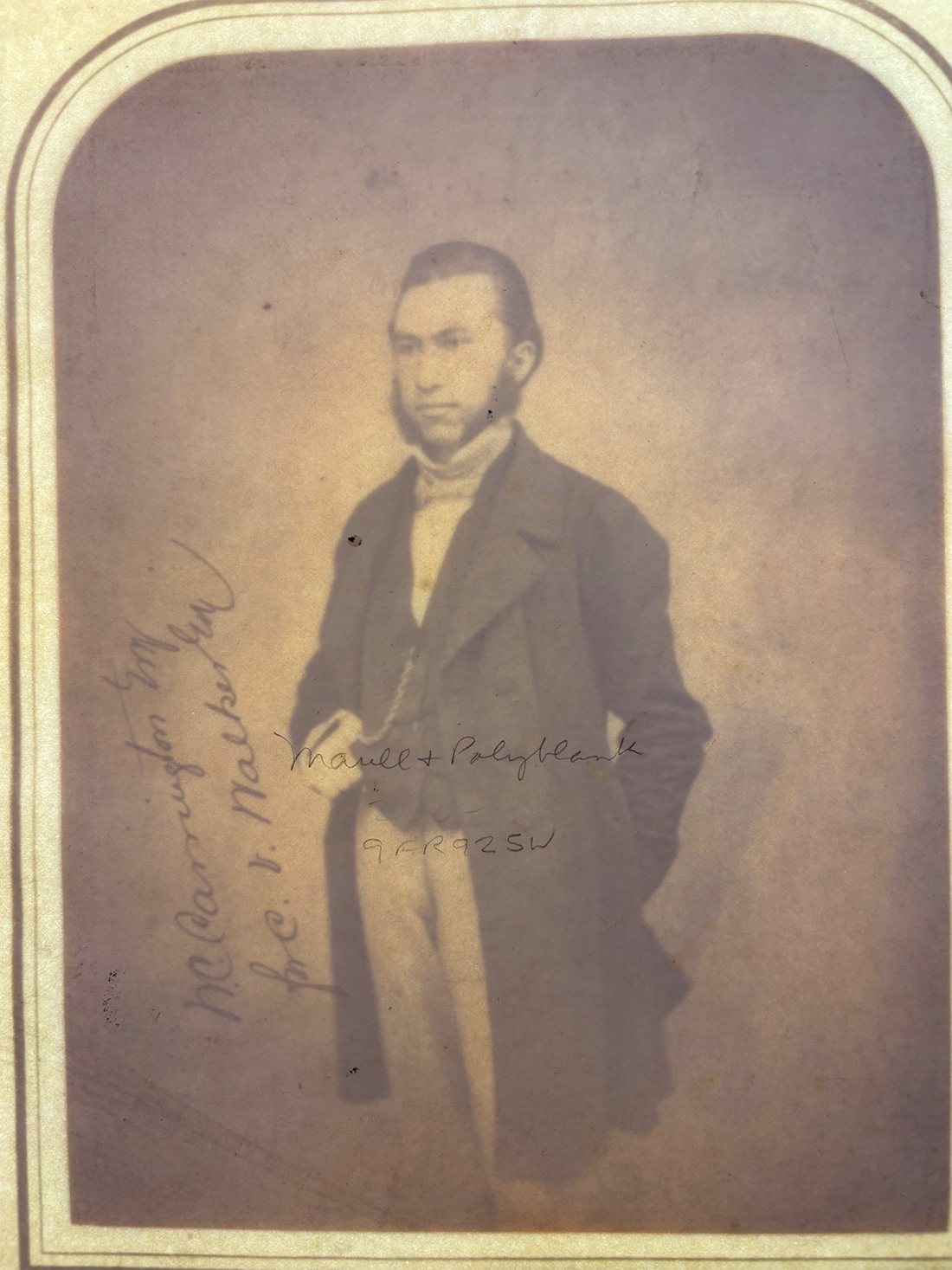
Bond believes that they now have an authentic image of Carrington, and are pleased to be able to display it at the Royal Astronomical Society, saying "it feels like he is coming home".
"I'm particularly hopeful that having an image of him will stop the online trend of using a c1900 photograph of Lord Kelvin as an image of Carrington, despite Kelvin wearing fashion from the 1900s and pointing to his mariners compass," Bond added. "Using Kelvin's photograph to portray Carrington is also a bit of an insult. Stuart Clark's excellent book The Sun Kings explains Kelvin's belief that the Sun was isotropic, despite Carrington's work observing sunspots and their links to magnetic storms."
More recently, AI has begun to spit out images of astronomer George Airy, another astronomer who did not support Carrington's work, and, vitally, is not Richard Carrington. Hopefully, now that we have an actual photograph, people can finally put the correct face to his name.
An article describing the discovery of the photograph is published in Astronomy & Geophysics.