Humans
 PUBLISHED



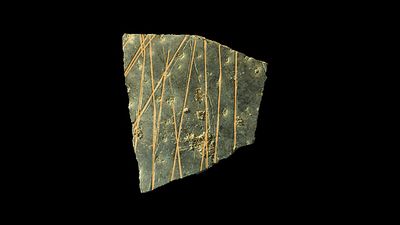


Around the time our ancestors left Africa and embarked on their first successful expansion into Eurasia, those who stayed behind came up with the rather clever idea to use ostrich shells as portable water containers. Not only that, but they engraved these delicate vessels with highly organized geometric patterns, demonstrating the impressive cognitive skills that enabled our species to invent symbolic forms of communication.
"We are talking about people who did not simply draw lines, but organized them according to recurring principles - parallelisms, grids, rotations and systematic repetitions: a visual grammar in embryo," said Silvia Ferrara from the University of Bologna, who directs the SAPIENCE – Symbols, Preliteracy and Code Evolution project this research is a part of, in a statement. “These signs reveal a surprisingly structured, geometric way of thinking.”
To learn more about the prehistoric engravings, Ferrara and her colleagues examined 109 ostrich eggshell fragments from three sites across South Africa and Namibia. Dated to around 60,000 years ago, these relics feature a combined total of 1,275 etched lines.
Using a series of statistical and geometric analyses, the researchers found that 83.4 percent of these lines appear as parallel pairs while around a third of all meetings between separate lines occur at right-angles. In more than 80 percent of fragments, the team noticed a co-occurrence of right-angles, line alignment and spatial regularity, indicating that whoever produced these designs had a pretty decent grasp of geometry.
"There is not only a process of repeating signs: there is real visuo-spatial planning, as if the authors already had an overall image of the figure in mind before engraving it," said Ferrara. Moreover, the creators of these prehistoric geometries employed cognitive operations such as rotation, repetition, translation and the hierarchical superimposition of signs in order to produce a number of more complex features, such as hatched bands, grids and diamond-shaped motifs.
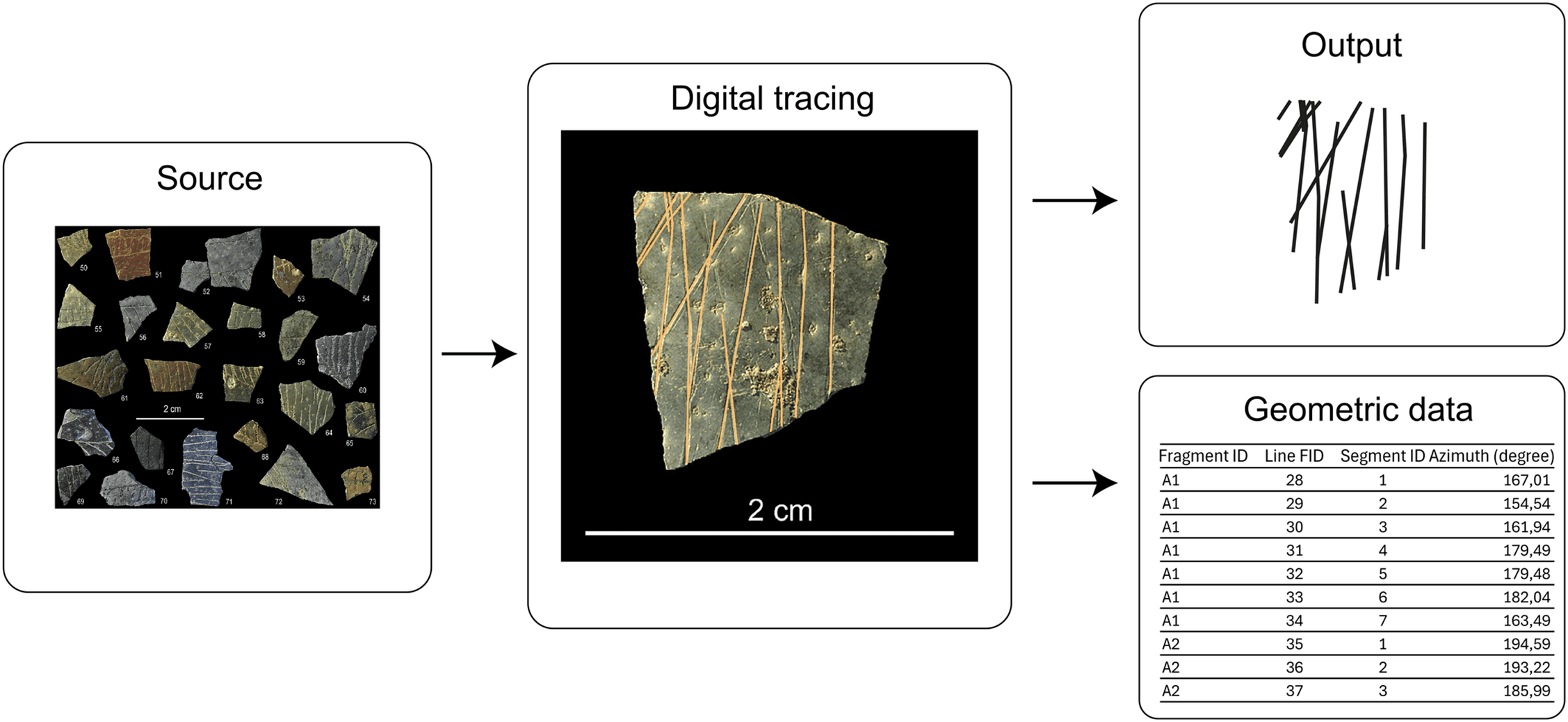
“The results demonstrate that Homo sapiens during the late [Middle Stone Age] mastered precise, pre-planned patterns anchored in specific geometric affordances: orthogonality [meaning the use of right-angles] and parallelism,” write the researchers. “What emerges is a ‘geometric grammar’.”
According to study author Valentina Decembrini, the ability to create visual configurations by adhering to a set of geometric principles hints at an innate capacity for abstract thought. This potential for symbolic construction and manipulation is key to the communication skills that make Homo sapiens so adaptable, and may have helped lead to our successful colonization of Eurasia some 60,000 years ago.
"What is particularly interesting here is that the designs are not just visually neat: they require planning, control, and consistency across multiple steps, and they rely on geometric properties that are cognitively salient," the study authors told IFLScience. "The discovery of this “visual grammar” reveals that these groups had fully modern capacities for planning, abstract thinking, structured production, and were able to transmit them."
This points to a shared practice, they said, where the skills and knowledge required to make these designs were taught and passed down over time.
The study has been published in the journal PLOS ONE.
This article was amended to include a statement from the study authors about the implications of their findings.