Humans
 PUBLISHED


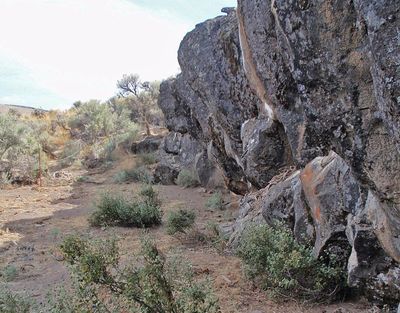


At a rockshelter in Oregon, archaeologists have unearthed an animal tooth that's been dated to be over 18,000 years old. If their interpretation of the artifact and other relics at the site is on point, this could suggest the shallow cave is one of the oldest sites of human occupation in North America.
The Rimrock Draw Rockshelter, found just outside the small town of Riley, has been carefully dug up by archaeologists led by the University of Oregon since 2011. Over the years, stone tools and tooth fragments from extinct mammals from the Pleistocene era have been unearthed.
In 2012, the team identified camel teeth fragments under a layer of volcanic ash from an eruption of Mount St Helens that was dated over 15,000 years ago. They also found two finely crafted scrapers made from orange agate, one covered in preserved bison blood residue and another buried in volcanic ash.
Now, radiocarbon dating of the camel tooth enamel has revealed a more precise date: 18,250 years before present.
“The identification of 15,000-years-old volcanic ash was a shock, then [the] 18,000-years old dates on the enamel, with stone tools and flakes below, were even more startling,” Patrick O’Grady, an archaeologist from the University of Oregon’s Museum of Natural and Cultural History Archaeological Field School, said in a statement.

“This is a very exciting development for the archaeological community,” added Heather Ulrich from the Bureau of Land Management Oregon and Washington Archaeology.
The question is whether the animal tooth fragment from 18,000 years ago can categorically prove human occupation at the site. The presence of crafted stone tools suggests so, but the interpretation might not necessarily convince everyone.
The subject of humans’ first forays into North America is one of the most hotly debated subjects in archaeology. Until recently, the commonly held view was that the earliest inhabitants in the Americas were a single group known as the "Clovis culture" that settled in the continent around 15,000-13,000 years ago.
That date has been continually pushed back by a number of archaeological finds in the past few decades, but a consensus is yet to be reached. In 2020, archaeologists carried out a dig at Chiquihuite Cave in central Mexico, which contains an array of some 2,000 stone tools, plant remains, and environmental DNA. Dating of the site suggests the cave was inhabited by humans seasonally 25,000-33,000 years ago, although other archaeologists argue there would “undoubtedly be challenges to this interpretation.”
The researchers from the recent Rimrock Draw Rockshelter excavation hope to carry out further analysis of their finds to gain sturdier evidence. This will include further testing of other camel and bison teeth fragments, as well as studying plant remains found at the site of a fire.
The team also made the point that passers-by and campers should keep their hands off any potential archaeological discoveries they stumble across as it might scupper their hard work.
“These discoveries highlight the importance of good stewardship of our public lands. Damage, destruction, or removal at an archaeological site is a federal crime. Leave what you find and do not collect artifacts or otherwise harm archaeological sites on public lands,” the Bureau of Land Management Oregon said in the announcement.