Health and Medicine
 PUBLISHED



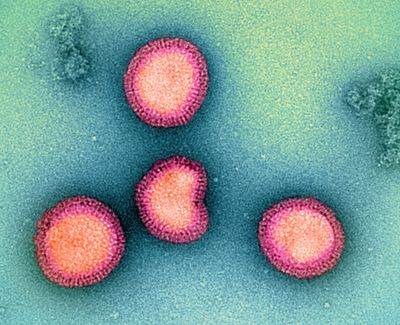


The flu season in the northern hemisphere has bolted out of the gate and appears to be off to an unusually early start, so if you're thinking about getting vaccinated, it would be unwise to sit around and wait.
Every flu season is a little bit different, but in the Northern Hemisphere it generally starts to ramp up in October or November, before peaking between December and March, typically in February.
Flu levels are low, but rising more than normal
In 2026-27, however, the US Centers for Disease Control and Prevention (CDC) has reported that flu cases started to rise through September, several weeks before usual.
The number of reported infections is still very low, so it’s unclear how the trajectory might continue from here. Additionally, the statistics can appear unusual at the start of the season because so few people are being tested compared with peak season.
Nevertheless, something unusual does appear to be occurring.
“There is something afoot,” Caitlin Rivers, an American epidemiologist at the Johns Hopkins Center for Health Security, wrote in her newsletter Force of Infection on September 27.
Dr Rivers noted that cases appear to be especially high for this time of the year in the Pacific states of California, Washington, Alaska, and Hawaii.
“For now, the early signal is concentrated in the West, with most of the country still at low levels. If you live in the Pacific states, consider getting a flu shot soon rather than waiting until later in the fall,” she wrote.
Not just a US problem
But it isn’t just the US feeling the pressure. Japan has been battling an extreme early flu season spike since August.
By September, Japanese schools had been shut down, while the Ministry of Health, Labor, and Welfare urged the public to avoid crowded places when feeling unwell, keep rooms well ventilated, and thoroughly scrub hands with soap after being in public. As of early October, flu cases are continuing to climb.
Over in the UK, the country's Health Security Agency (UKHSA) said on October 8 that flu is currently at baseline levels, although there are indications of an early start to the season.
“Flu levels are increasing with the possibility of an early flu season, so now is the time for those eligible to get vaccinated,” Dr Jamie Lopez Bernal, Consultant Epidemiologist at UKHSA, said in a statement.
Putting a strain on things
Just like a family tree, influenza can be split into different branches depending on how the viruses are related to each other.
Seasonal outbreaks are usually caused by a few different forms of flu: two subtypes of influenza A, H3N2 and H1N1, and influenza B, which is divided into lineages rather than subtypes.
Unlike influenza A virus, which can also infect animals, influenza B almost exclusively infects humans and is not associated with global pandemics because it mutates relatively slowly.
Each year, ahead of flu season, scientists must forecast which strains of each form will be the most common, then use that prediction to tailor the annual vaccine.
The vaccine is trivalent, so it works against all three types of flu virus. However, it has to be slightly tweaked each year to specifically target the strains in circulation. Sometimes they're right on the money; other times they're a little bit off.
CDC data from the end of September 2026 suggests that up to 96 percent of cases in the US were caused by H1N1, while under 4 percent were H3N2. Cases of Influenza B weren’t even registered.
Last year, however, it was H3N2 that became globally dominant, specifically a strain that had several unique mutations that some people were vulnerable to. Unfortunately, it differed slightly from the predicted H3N2 strain in the 2025-26 vaccines, although the shot still offered some protection.
Known unknowns of the 2026-27 flu season
It’s still too early in the season to say whether this year’s vaccine is the right match, and there's no promise that H1N1 will continue its dominance over winter through the next six months.
But on a slightly separate note, early analysis is suggesting that some cases of H1N1 currently in circulation contain a worrying mutation known as G155E.
“We saw that a number of strains which have the G155E mutation are, in some cases, less well recognized by pre-existing human antibodies,” Jesse Bloom, a virologist at the Fred Hutchinson Cancer Center in Seattle, told Nature News.
This vulnerability might be especially significant in the antibodies of teenagers and young adults, he said.
None of this should be scaremongering; just because there's an early start to the season doesn't necessarily mean it will be an aggressive one.
Nevertheless, the overwhelming consensus from experts is clear: if you haven't already, you should seriously consider getting an annual flu vaccine sooner rather than later, especially if you're older, pregnant, or have any underlying health conditions that could leave you more vulnerable to flu.


 1
1