Space and Physics
 PUBLISHED




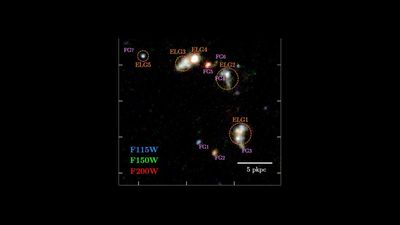


Galaxy merger is a crucial process in galactic evolution that has happened since the first galaxies came into being. Now JWST has spotted a truly incredible group of five galaxies merging in the early universe.
Because it takes time for light to travel large distances, the quintet's collision in the far-off reaches of space happened when the universe was just 800 million years old. Such a five-way merger would be rare anywhere in the universe, but even moreso during its youth, making this a surprise for researchers.
“What makes this remarkable is that a merger involving such a large number of galaxies was not expected so early in the universe’s history, when galaxy mergers were thought to [be] simpler and usually involve only two to three galaxies,” lead author Dr. Weida Hu, from Texas A&M University, said in a statement.
When a big galaxy snatches a smaller one, it can rejuvenate the larger object. The collision between two galaxies of similar sizes creates new geometry, often turning spirals into elliptical galaxies.
If the number wasn't enough of a surprise, the researchers report that the system is enriched with heavier elements, such as oxygen, at a level not expected until 1 billion years after the Big Bang. These elements are formed by nuclear fusion inside stars, and their abundance appears to be a result of these galaxies producing stars at a rate of 250 solar masses per year, far higher than the average at the time.
The galaxies are separated by just tens of thousands of light-years, which means the whole group occupies a relatively small volume of space. By comparison, the closest galaxies to the Milky Way, the dwarf galaxies known as the Large and Small Magellanic Clouds, are over 160,000 light-years away. Andromeda, which may be doomed to merge with our galaxy in the distant future, is over 2.5 million light-years away.
The team was also able to show the presence of oxygen and hydrogen around the galaxies. Oxygen can only have formed within the galaxies, where stars are enriching the interstellar medium. The interactions between the members of the quintet might have thrown the elements into intergalactic space, showing that even back then, mergers played a major role in shaping both galaxies and their environments.
“By showing that a complex, merger-driven system exists so early, it tells us our theories of how galaxies assemble — and how quickly they do so — need to be updated to match reality,” added coauthor Professor Casey Papovich.
JWST has previously identified massive galaxies in the early universe that look surprisingly mature. If merging events similar to this were common, they could have driven the formation of those other unexpected objects. Clearly, the early universe remains a mystery, and further observations from JWST are needed.
The paper is published in the journal Nature Astronomy.