Nature
 PUBLISHED


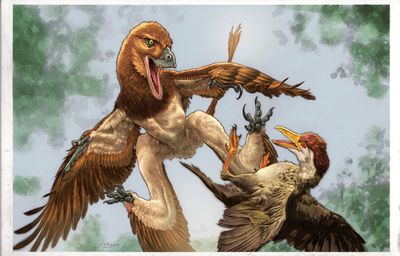


In 1981, scientists serendipitously discovered a repository of bird fossils from the Lower Cretaceous period in the village of Changma in China while looking for fossil fish. It turned out to be a boon, providing more than 100 avian skeletons, some even having preserved feathers and skin. The latest discovery from the site is something even more extraordinary – a new species of non-avian dinosaur, and it might explain something strange about the ancient bird bones.
“Scientists have found these weird, broken-up clusters of bird bones at this site, and we didn’t know what made them. This new microraptor dinosaur, Jian changmaensis, is our best guess,” said Jingmai O’Connor, the associate curator of fossil reptiles at the Field Museum in Chicago and senior author of the paper describing the new species, in a statement. “It’s the only dinosaur found at this site that wasn’t a bird, it was a carnivore, and it was much bigger than everything else that we’ve found there.”
The new species is the first non-avian dinosaur to be found in the area; its name, Jian changmaensis, is taken from the one winged bird known from Chinese mythology and the area in which the fossil was found. It is described from a left pectoral girdle – essentially the shoulder bones of the dinosaur – and the forelimb, which were preserved in mudstone.
The specimen was CT scanned to give the researchers more information about the joints and details of the fossil, which led them to classify the new species as a “microraptorine dromaeosaurid theropod”, meaning that it belongs to a group known as the microraptors. These belong to the dromaeosaur family, which also includes Velociraptor. Analysis also helped to fit the specimen in between other known microraptors; the team think it might have a close relationship with another species called Microraptor zhaoianus.
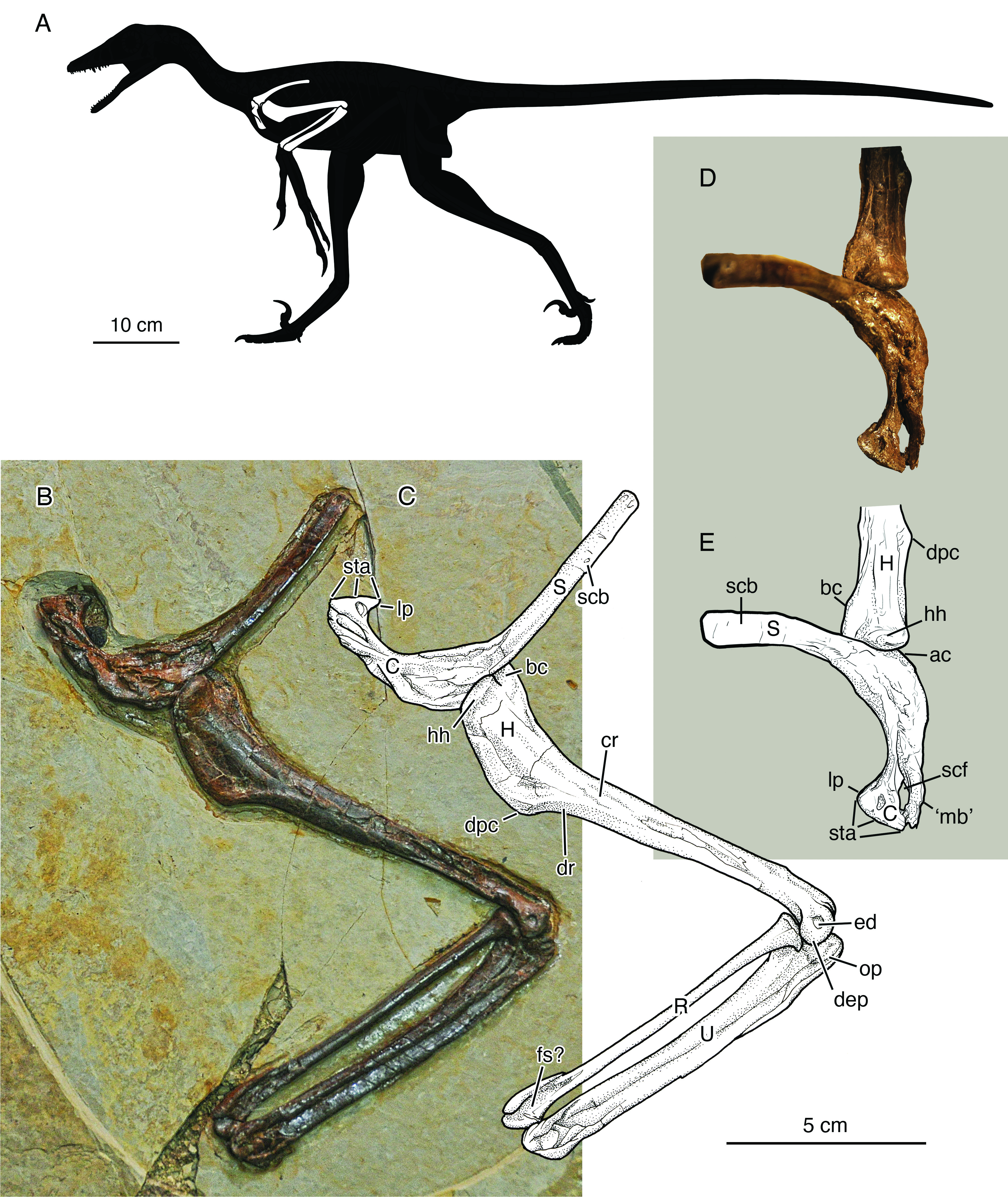
Microraptors were typically small, but this new species is significantly larger. “Jian is one of the biggest microraptor specimens that has ever been found,” said O’Connor. “The piece of its upper arm bone that we have is about 4 inches long, so the entire dinosaur probably had something like a four-foot wingspan, around the size of a barn owl.”
The researchers also think it would have had the appearance of four “wings”, although not for flying like a bird. “Jian and the other microraptors probably weren’t capable of true, powered flight, but they could probably glide like a flying squirrel,” said O’Connor.
Speaking to the importance of this new discovery, Matt Lamanna, corresponding author of the study and Carnegie Museum of Natural History’s Mary R. Dawson Curator of Vertebrate Paleontology and senior dinosaur researcher, said: “Jian provides critical new insight into the biological history of the Changma region and the ecological context of the ancestors of today’s birds.”
“You cannot understand life on the planet today without looking at its origins,” added O’Connor. “Birds are arguably the most successful group of land-dwelling vertebrate animals on Earth today. Learning about early birds and their close non-bird dinosaur relatives gives us a better understanding of what made the group of birds that survived so special.”
The study is published in Annals of Carnegie Museum.