Space and Physics
 PUBLISHED





Our technology loses a lot of energy as heat. For computing technology, the heat isn’t only a problem because the energy is wasted; it can also slow down or damage your device. You don’t want your phone or computer to overheat, so a solution might be a material that's better at heat dissipation – and researchers might have just found it.
As thermal management materials go, copper is king. It accounts for 30 percent of all commercial thermal-management materials thanks to its excellent thermal conductivity of 400 watts per meter-Kelvin.
Now, researchers led by Yongjie Hu, at the University of California, Los Angeles (UCLA), have discovered metallic theta-phase tantalum nitride (θ-TaN). This material has an ultrahigh thermal conductivity of approximately 1,100 watts per meter-Kelvin.
“Our research shows that theta-phase tantalum nitride could be a fundamentally new and superior alternative for achieving high thermal conductivity and may help guide the design of next-generation thermal materials,” Hu said in a statement.
The value is a new record for metallic materials, and the team goes so far as saying that it is redefining how heat transfer happens in metals. In fact, the secret to the high thermal conductivity is to be found at the atomic level in this curious material.
Metals are known to be excellent conductors of heat and electricity. This property is due to the atomic bonds in metal that allow for electrons to freely move. When it comes to heat, there is a second mode of transfer, and it is done via atomic vibrations. Those vibrations behave like a particle; for that reason, they are modeled as a quasiparticle called phonons.
Electrons and phonons often have strong interactions. While metals are excellent conductors, these interactions limit the intrinsic efficiency of heat transfer, putting a barrier on how well heat can flow in metals.
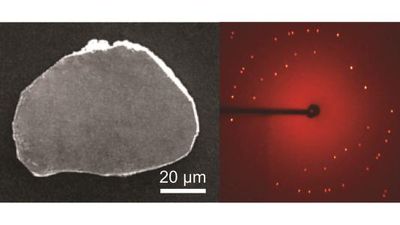
The team did theoretical modeling and saw that the theta-phase tantalum nitride had a truly unique atomic structure that produced weak phonon-electron interactions. To see if this was the case in practice, the team used the Advanced Photon Source (APS) at the US Department of Energy’s Argonne National Laboratory to study the microscopic properties of the material. They blasted the material with high-energy light to see what was going on. The high-resolution X-ray observations confirmed the extremely weak electron-phonon interactions.
“The enhanced capabilities of the upgraded APS made these precise measurements possible,” added Argonne scientist Ahmet Alatas. “Together, experiment and theory provide a microscopic explanation for the record-high thermal conductivity.”
A paper describing the results is published in the journal Science.