Space and Physics
 PUBLISHED
 1
1



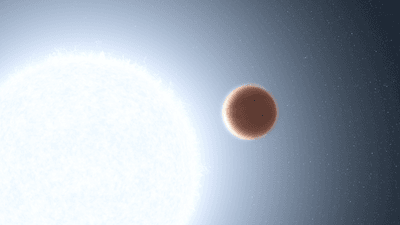


Astronomers from the National Astronomical Observatories of China have detected the heaviest single element in the atmosphere of an exoplanet. The planet, MASCARA-4, is what's known as an ultra-hot Jupiter. It’s 3.1 times the mass of our gas giant, but with a temperature in the thousands of degrees – and its extremely hot atmosphere shows traces of samarium.
If you don’t know the element samarium, don’t be too hard on yourself. It is a rare-Earth element and not enough of a household name, although it's more common in the Earth’s crust than metals such as tin. Clearly, tin has got a better PR team. Samarium has an atomic number of 62, which makes it the heaviest element detected in a planetary atmosphere.
“Every star and planet should contain these elements from birth. The question is why they are so abundant to be detected,” corresponding author Dr Wei Wang told New Scientist. “Given their large atomic number, they should usually reside in high-pressure low-altitude regions and not be easy to detect.”
While samarium is the heaviest known element in an exoplanet's atmosphere, this planet also has another unique trait: Rubidium (atomic number 37) has been found there. The first time this element has been found in the atmosphere of an exoplanet. The team confirmed previous detections of magnesium, calcium, chromium, and iron. The team also spotted barium and titanium, and possibly scandium.
The titanium presence is intriguing as it has previously been detected in the atmospheres of ultra-hot Jupiters as titanium oxide, arranged in ozone-like layers. Titanium here was detected as an element, so maybe there is little oxygen available not only to construct these atmospheric layers but also to react with samarium. Samarium in Earth’s air reacts with oxygen and water vapor, suggesting that these substances might be missing from this specific exoplanet.
The team used the Very Large Telescope in Chile to measure starlight as the planet passed in front of it. The atmosphere filters the light, and using a spectrograph it is possible to determine the type of elements that are present in the atmosphere of this planet.
The star is a class A, hotter and bigger than our Sun. Given how close this planet is to it (less than five percent of the Earth-Sun distance) the light is truly doing a number on its atmosphere.
The team hopes for follow-up observations that can confirm the presence of these new chemical elements identified as well as discover more elements and molecules and refine how much of each is there in the atmosphere. Comparing the planets' compositions with their host stars “should shed light in the understanding of the formation and evolution of planets and their atmospheres.”
The paper is accepted for publication in The Astronomical Journal and it is available on ArXiv.
[h/t: New Scientist]