Space and Physics
 PUBLISHED
 1
1



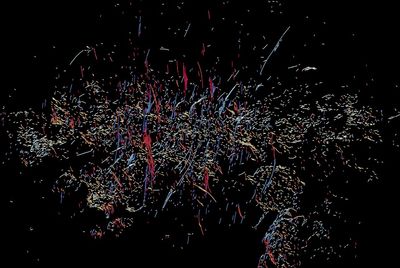


Over the last few decades and especially in recent years, peculiar filaments have been discovered stretching vertically near the Milky Way’s supermassive black hole, Sagittarius A*. They extend for 150 light-years and they are so thin they look one-dimensional. Now, a new population has been found: they are shorter and lie horizontally, pointing directly to Sagittarius A*.
The new filaments are about five to 10 light-years long, much smaller than the vertical ones discovered before. They are related to the activity of Sagittarius A*, but it is unclear if the two types of filaments are related. The vertical ones are magnetic accelerating particles close to the speed of light, the horizontal ones instead appear to emit heat, accelerating thermal material in a molecular cloud.
The vertical filaments also outnumber the horizontal ones and are more clearly visible in radio waves, so the team was not expecting to find this new population.
"It was a surprise to suddenly find a new population of structures that seem to be pointing in the direction of the black hole," said Professor Farhad Yusef-Zadeh from Northwestern University, who first discovered the giant vertical filaments in the 1980s.
"I was actually stunned when I saw these. We had to do a lot of work to establish that we weren't fooling ourselves. We found that these filaments are not random but appear to be tied to the outflow of our black hole. By studying them, we could learn more about the black hole's spin and accretion disk orientation," Prof Yusef-Zadeh explained, adding "It is satisfying when one finds order in a middle of a chaotic field of the nucleus of our galaxy."

The newly discovered filaments are estimated to be about 6 million years old. Sagittarius A* may have had a burst of activity then.
"We think they must have originated with some kind of outflow from an activity that happened a few million years ago," Yusef-Zadeh said. "It seems to be the result of an interaction of that outflowing material with objects near it."
The team has been finding more and more of these filaments, thanks in part to more sophisticated radio observatories such as the South African Radio Astronomy Observatory's (SARAO) MeerKAT telescope. Still, it required a lot of work to isolate the filaments from the background.
"The new MeerKAT observations have been a game changer," Yusef-Zadeh said. "The advancement of technology and dedicated observing time have given us new information. It's really a technical achievement from radio astronomers."
The study is published in The Astrophysical Journal Letters.