Nature
 PUBLISHED


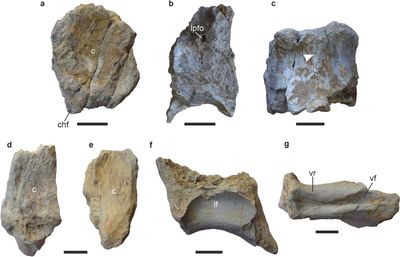


Archaeologists from the Indian Institute of Technology and the Geological Survey of India have recovered the remains of a new dinosaur that has never been seen in India before. The new fossil belongs to a species of dicraeosaurid sauropod – a long-necked “veggiesaurus” that lived in the area during the Middle Jurassic era. The fossil is not only the first of its kind but also the earliest known diplodocoid found in the world.
The researchers have named the new species Tharosaurus indicus. According to their analysis, T. indicus has a long depression on the side of its neck bones and neural spines that are not seen in other members of the group. The team believe they are evidence of spikes, potentially similar to those that appear on Bajadasaurus pronuspinax, another member of the Dicraeosauridae family. The ancient animal also appears to have a frontal vertebra surface near its tail bone that is reminiscent of a heart shape.
Sauropods are thought to have originated at some point in the Late Triassic or Early Jurassic era, but the origins of Neosauropoda, of which Diplodocoidea belong, is still unknown and quite contentious. However, the new spiny-dino could help address this issue.
Palaeobiogeographic consideration of T. indicus, in relation to other Indian Jurassic sauropods, suggests that it is a leftover from a lineage that appeared in India and then dispersed across the rest of the then supercontinent, Pangaea. From around 300-200 million years ago, the continents of North America, Africa, South America, and Europe were all one large landmass.
The fossil was discovered in the Thar Desert, not far from Jaisalmer in the state of Rajasthan. During the Mesozoic Era (between 252 and 66 million years ago), this part of the country was actually a shoreline along the Tethys Ocean. The researchers believe that this area possibly played an important role in the emergence of neosauropods – a subgroup of sauropods that also had long necks and fed off vegetation.
The researchers believe their find is likely just the first of many more to come, but other similar fossils discovered in the area suggest that the region played a role in the evolution of many vertebrates.
More work is needed to identify other members of this species and to compare them to other sauropod species found in Asia. This will help fill in the gaps of how these animals became dispersed and where they originally came from.
The study is published in Scientific Reports.