


 Space and Physics
 PUBLISHED

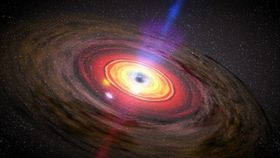


In the closest near-miss event to be spotted near our galaxy, one lucky star escaped a supermassive black hole with just minor damage. The black hole took a Jupiter-sized bite out of this nearby star, but at least it wasn’t swallowed whole and lives to tell the tale.
The immense gravity of supermassive black holes -- which are thought to reside at the center of all big galaxies -- can and do tear up entire stars and any other objects that might wander too close. When a star gets shredded by the black hole’s tidal forces, a bright flare of light is emitted. This is called a “tidal disruption event,” and they’re thought to occur once every 10,000 to 100,000 years.
The star that got away is located in a galaxy outside of the Laniakea Supercluster (where the Milky Way resides), some 650 million light years away toward Ursa Major. If Laniakea is our galactic hometown, then this event happened in our larger metropolitan area. “There’s only one local neighborhood,” Ohio State’s Krzysztof Stanek says in a news release. “It’s like getting the local newspaper. You want to know what your neighbors did.”
The Ohio State team didn’t see the star itself. Rather, using four 15-centimeter telescopes of the All-Sky Automated Survey for Supernovae (ASAS-SN) in Hawaii, they managed to observe the light that flared as the black hole captured some of the star’s material. This tidal disruption event -- the closest ever spotted -- first flared to brightness on January 25 of this year between the stars Alula Borealis and Praecipua. After follow-up observations using several ground and space-based telescopes, the team finally placed the object within its host galaxy, called SDSS J110840.11.
Based on the amount of energy released, the researchers calculated that a relatively small amount of stellar material -- one thousandth of the mass of the sun -- had been sucked into the black hole. That amount is about equal to the mass of Jupiter.
Until now, only a handful of tidal disruption events have been spotted. Black holes don’t seem to consume whole stars that often, but what about just tearing off a piece like this one? “The issue is that the chances of a black hole partly shredding a star may not be all that different from the chances of it completely shredding a star,” Ohio State's Christopher Kochanek says. “We just don’t know.” One of ASAS-SN’s goals will be to determine how often tidal disruption events happen in the nearby universe.
The findings will be published in Monthly Notices of the Royal Astronomical Society.


