Humans
 PUBLISHED



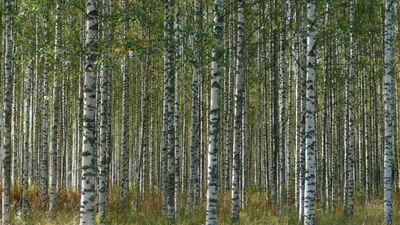


Birch tar was among the most useful materials available to prehistoric humans and was primarily used as a glue to bind stone blades onto wooden handles or arrowheads onto shafts. However, we now have evidence that the sticky black substance served a number of other purposes, and new research suggests that Neanderthals may even have treated wounds with it to prevent them from becoming infected.
Distilled from the bark of birch trees, birch tar – also known as pitch – has been identified at Neanderthal sites dating back at least 180,000 years. It was also used by ancient Homo sapiens and continues to be employed by some Indigenous communities today.
The Mi’kmaq people of Eastern Canada and the Saami of Lapland, for instance, are known to use birch tar extracts to prevent injuries from becoming infected with gram-positive bacteria such as Staphylococcus aureus. These are among the most common wound-infecting bacteria and differ from their gram-negative cousins in that they lack an additional outer membrane to protect them from antimicrobial agents.
Researchers therefore decided to distil birch tar from two species of birch tree that are known to have been common in Europe during the Late Pleistocene, when Neanderthals still roamed. They distilled the pitch using two prehistoric methods that relied on clay and stone materials, and one more modern technique employed by the Mi’kmaq that uses tin cans.
Results indicated that birch tar produced using all three methods inhibited the proliferation of S. aureus, but not gram-negative bacteria like E. coli. This suggests that the pitch made by Neanderthals was just as effective as that made by the Mi’kmaq and Saami at preventing infections.
“We found that the birch tar produced by Neanderthals and early humans had antibacterial properties,” write the study authors. “This has important implications for how Neanderthals may have mitigated disease burden during the last Ice Ages, and adds to a growing set of evidence on healthcare in these early human communities.”
And while it’s impossible to say for sure if Neanderthals really did use birch tar as a topical antibiotic, study author Tjaark Siemssen told IFLScience that these findings align well with recent research into the medical expertise of these extinct hominins. “If we’d conducted this research 30 years ago, it would have probably faced a lot more skepticism, but the past few decades have shown a wide range of evidence of medicinal practice among Neanderthals,” he says.
“We're seeing, for example, the use of chamomile and yarrow”, both of which have been detected in Neanderthal dental calculus and are known to have medicinal properties. “We also find mushrooms that have maybe hitherto been ignored, but now we realize that they also may have had medicinal uses because they certainly weren't there for food,” says Siemssen.
For example, penicillin molds found in the dental plaque of a Neanderthal in Spain indicate that this particular individual may have chewed on moldy material in order to harness this well-known antibiotic to treat a dental abscess. Meanwhile, the discovery of a Neanderthal skeleton with a healed broken leg at the famous Shanidar Cave suggests that this archaic human species possessed both the intelligence and the compassion to care for wounded members of their communities.
As they sign off, the study authors leave us with an intriguing final thought, explaining that the more we learn about the healing practices of Neanderthals, the more we can learn from them by reconnecting with ancient medical wisdom. “As today’s world is facing an antibiotic crisis, seeing increased antibiotic tolerance of bacterial strains, engagement with traditional remedies becomes ever more important,” they write.
The study has been published in the journal PLOS ONE.