Humans
 PUBLISHED
 9
9



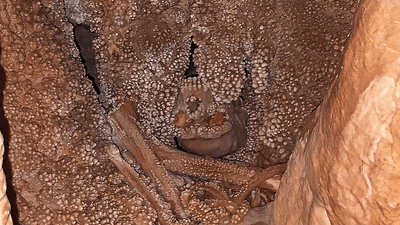


In 1993, researchers working inside the Lamalunga cave in Altamura, southern Italy, stumbled across a 10-meter (32-foot) sinkhole. Exploring it, they found it led to a tunnel around 60 meters (197 foot) long, at the end of which was a very strange sight; the fossil of an adult male, now known to be a Neanderthal who died between 128,000 and 187,000 years ago, was embedded in the cave wall.
The rest of this article is behind a paywall. Please sign in or subscribe to access the full content.Though it could easily be explained, the appearance of the fossil – now known as Altamura Man – must have been quite startling. The remarkably well-preserved skeleton was covered in "cave popcorn"; tiny, spot-like marks, positioned all over the man's body.
So, what is cave popcorn, and is it as delicious as non-cave popcorn? When calcite is dissolved in rainwater it can then accumulate on the surface of the cave floor, or whatever happens to be on the floor. Sometimes that can mean animal remains, and in this case it was the most complete remains of a neanderthal ever found.
"Cave popcorn usually occurs in wet areas of the cave where water can flow on the surface," Lee-Gray Boze, a physical scientist from the United States Geological Survey, told How Stuff Works. "Many of the longest cave systems tend to be drier, with some notable exceptions, and these dry areas tend to be less decorated. However, in the wet areas, cave popcorn is a common feature, usually indicating a wet environment and air flow."
"Other common environments can include dripping water, in which the drips may cause popcorn to form in a radius around the drip sites."
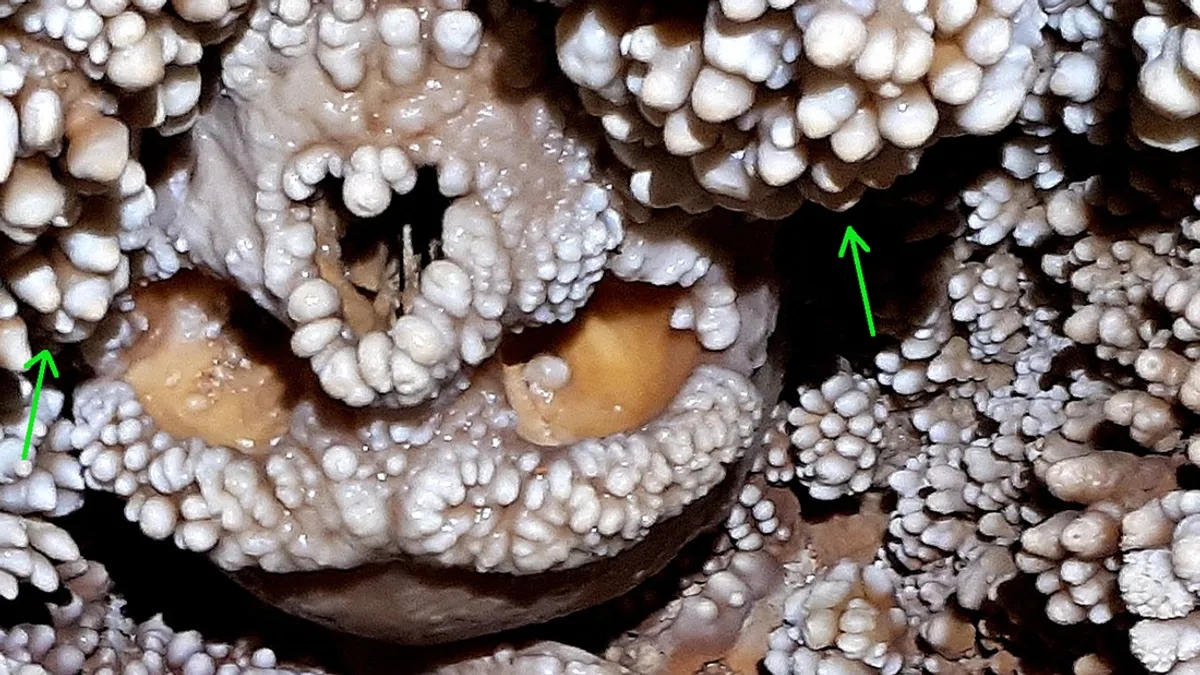
As well as looking bizarre, the cave popcorn helped one team discover the likely cause of the ancient man's death.
"Faunal remains found in some of the galleries are often isolated bony elements accumulated in depressed areas of the cave, suggesting that they were transported and dispersed by water," one team investigating the body found.
"This was not the case with the human skeleton, given that it is largely represented and concentrated in a small area. Thus, we may hypothesize that, after death and decomposition of the body, the skeleton collapsed where it has been found."
The team believe that the man had probably fallen into a sinkhole and gotten stuck. There he likely starved or died of dehydration before being covered in cave popcorn and discovered by scientists over 100,000 years later.
The fossil was left where it was, as disturbing it could have caused irreparable damage. For a time, scientists were left to study the body by taking observations on site or analysing photographs taken by other scientists.
But in 2015, one team was able to take a sample of the skeleton (a fragment of its shoulder blade) for analysis. It was then determined that the fossil wasn't a Homo sapiens, as others had theorized, but a Neanderthal who had met his maker between 128,000 and 187,000 years ago.
"Overall, the results of our morphometric and the paleogenetic analyses concur in indicating that the skeleton from Altamura belongs to a Neanderthal," the team wrote in their study.
Further analysis of the man's teeth by another team in 2020 found evidence of wear, suggesting he was an adult – though not old – at the time of his unfortunate death. They also found that one of his teeth was likely lost a few weeks before his death "since the other teeth of the right maxillary arcade had enough time to rearrange their position along the tooth row". The tooth, they add, "must have been lost a few weeks before death.". All in all, it wasn't a great few last weeks.
In recent months, Altamura Man has undergone further examination. Previously, researchers had believed Neanderthals had structures within their noses that helped them cope with cold environments, but due to how delicate the bones of the nasal cavity are, we had no fossilized evidence of this structure. Enter the remarkably well-preserved Altamura Man.
“The first time I got into the cave and realized how well preserved the nasal cavity was, I was amazed, because I have seen many crania in our labs and I know that these structures are often destroyed,” study author Costantino Buzi told IFLScience.
Having examined the specimen, the team concluded that Neanderthals didn't actually possess these specific cold-climate adaptions, and instead they had an inner nasal cavity that is surprisingly similar to those seen in modern humans.
“We can finally say these traits don't exist, so we can remove them from the diagnostic list of traits [for Neanderthals]," added Buzi. But this doesn't mean that Neanderthals weren't suited to the cold at all.
“To put it simply, by looking at the interior portion of the nose, we can see that Neanderthals had their own solution for adapting airflow for the cold climate,” he added. “So they were cold-adapted in the face with a different model from our own.”
We will likely learn more about Neanderthals from this unique specimen. So while his death was a spot of personal bad luck, it's pretty helpful for science that he took that unfortunate walk all those years ago.