Space and Physics
 PUBLISHED
 1
1


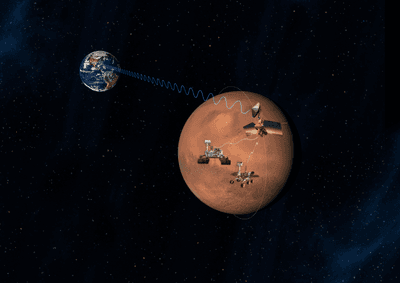


This week, Jeff Bezos’ Blue Origin was awarded a contract to develop NASA’s Mars Telecommunications Network. This is a proposed new communication system for more reliable and higher-bandwidth connections to the red planet. This is key for both communication and navigation, currently of the robotic explorers on Mars and in the future, of humans.
The contract has a maximum potential value of $700 million, and the space company needs to deliver its orbiter by December 31, 2028. Blue Origin will also launch the spacecraft.
It is not specified in the press release, but by having the orbiter ready for that date, NASA appears to be aiming to send it up then. December 2028 and January 2029 are within of the minimum-energy launch windows to send missions to Mars.
We do not know what this telecommunication satellite will involve, or what the actual technical requirements are for this device.
NASA has had plans for more efficient communications with the Red Planet for a while, and several tests were performed to pave the way for that goal.
What kind of telecommunications, though?
Last year, IFLScience interviewed Abhijit “Abi” Biswas, who works at NASA's Jet Propulsion Laboratory. He was involved in the Deep Space Optical Communications (DSOC), a two-year tech demonstration to test if optical communications can be used instead of radio waves.
The benefits are obvious once you know the tech. Using a laser light, a satellite can send data at rates up to 100 times higher than radio waves. That's a lot more information for your buck.
There are drawbacks too: radio waves work day and night, rain or shine. Optical light doesn’t work like that. Mars spends two-thirds of its time in the day sky from Earth’s perspective, and the presence of clouds could stop the light from the DSOC signal.
Still, the DSOC demonstration was a resounding success. The experimental tech was deployed on the Psyche spacecraft as a secondary communication system. It was used to send a video of Taters the cat to Earth from 31 million kilometers (19 million miles) away – to the delight of internet users.
It was tested as far as 460 million kilometers (290 million miles) from our planet. That’s 60 million kilometers (37 million miles) more than the farthest possible distance between Earth and Mars.
At a distance of 390 million kilometers (240 million miles) away, the sustained downlink rate from Psyche was 6.25 megabits per second with a peak of 8.3 megabits per second. Not broadband level but certainly faster than what you get via radio waves.
"The primary objective was to demonstrate that we can point lasers properly and achieve communications with transmitters and receivers on the ground," Biswas told IFLScience.
"I'm very pleased to let you know that our demonstration has actually worked extremely well. We have been able to meet all our level one requirements and indeed, in a sense, it has also exceeded expectations."
It’s not just about space infrastructure…
For DSOC to work, you need to have dedicated telescopes looking for those optical signals, just as there are radio antennas communicating with the various spacecraft around the Solar System.
The DSOC demonstrated that you can retrofit those antennas to work both in optical and in radio, which is a very clever way to use both. Whether this approach will actually bet picked up remains to be seen.
“The future is uncertain. [Laser communication] is not an ongoing effort, and what the path forward is to developing ground infrastructure (which is critical for operations) is still a question that NASA has to grapple with and come up with sponsorship and all that,” Biswas told IFLScience.
“We have lots of good ideas on how to do it. And that will be a conversation that will be held [...] in the next few years. But we do not have a plan in place to say that by such and such year we're going to have such and such infrastructure.”
There are also ideas of having the receiver in space, bringing the fast data into orbit and then sending it down to us. This would avoid the day length and cloud problem, but it would be a whole new level of expense all together.
“The key point to achieving the ‘Internet on Mars’ is ground infrastructure. Some people think that it's better to put the infrastructure in space because then you don't have cloud outages and such. My personal opinion, and this is strictly my opinion, is that that is much more expensive and a much longer-term solution,” Biswas told IFLScience.
We will see what Blue Origin is planning for this next-generation communicator and if that entails any of this experimental optical communication tech.